
The plastic tensile testing machine, revolutionized.
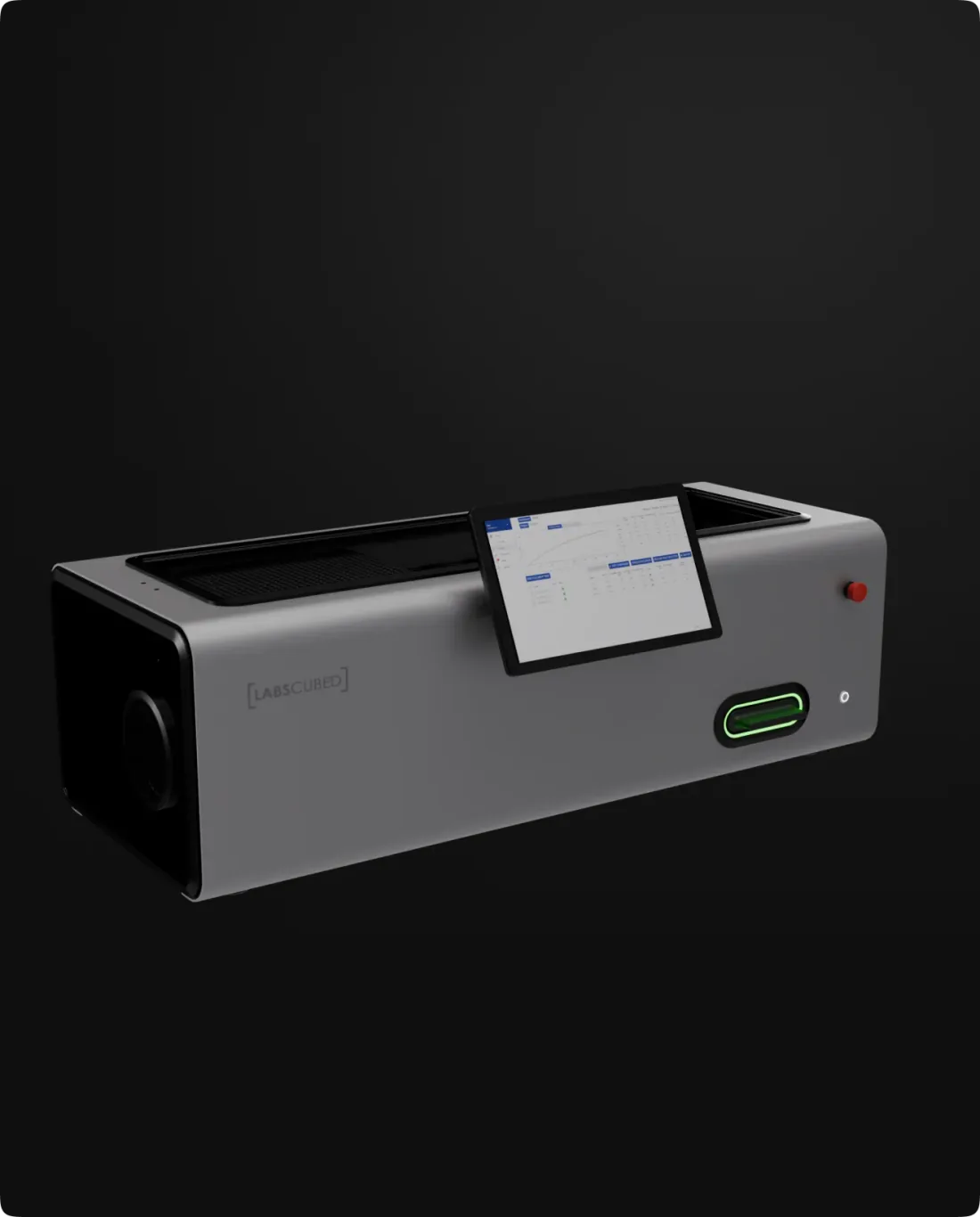
The CubeTen loads, measures, grips and pulls up to 15 plastic specimens unattended — ASTM D638 and ISO 527 results your whole lab can trust.


Built to remove every variable.
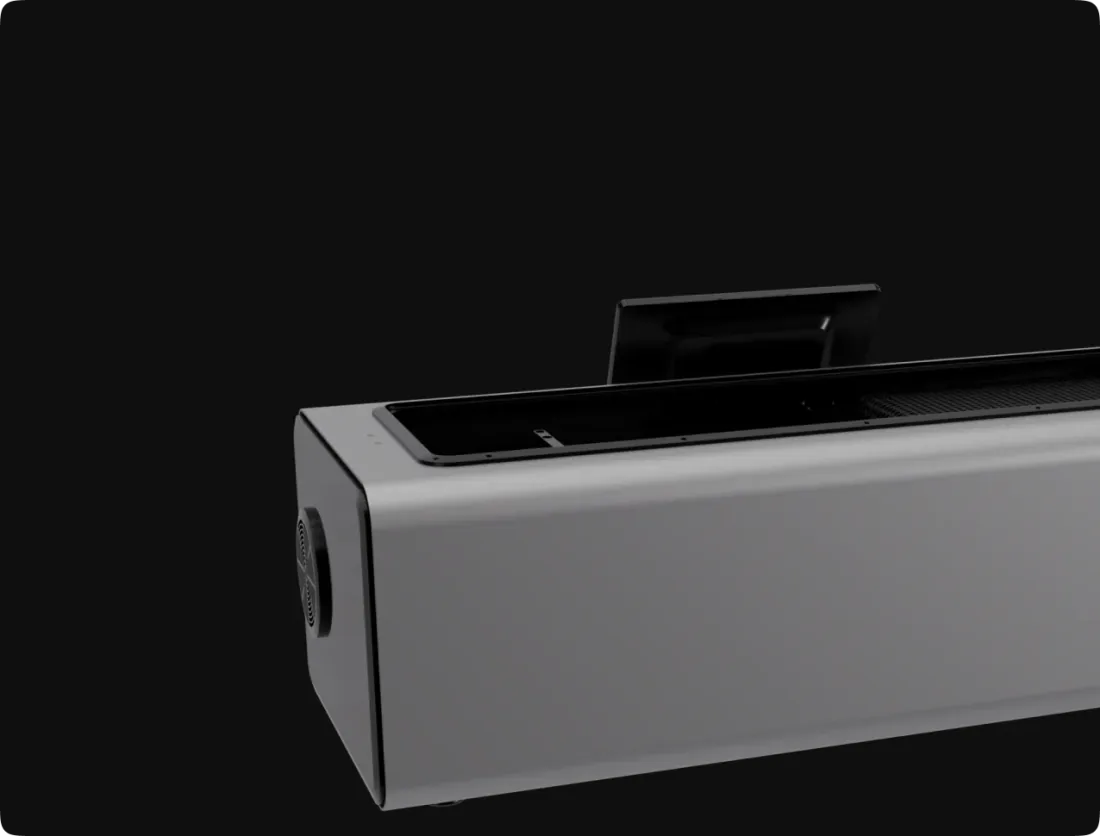
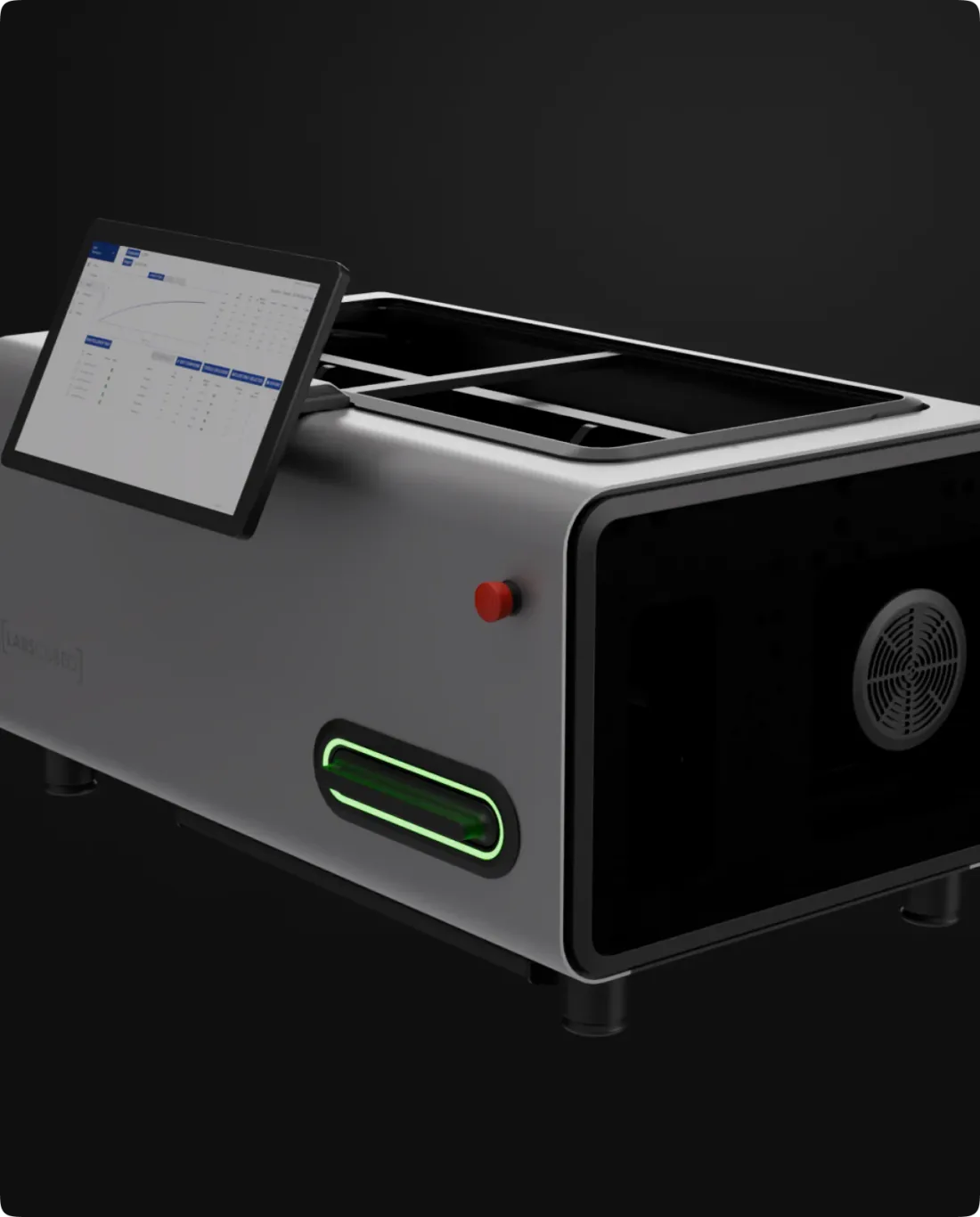
The CubeTen is a user-friendly automated testing machine designed specifically for plastics and adhesives.

Recover lab time
Load the tray and walk away — the CubeTen saves up to 95% of your team's testing time for higher-value work.

Optimize your lab
Maximize ROI while accelerating lab results and making better use of every technician hour.

Ensure data consistency
Automated testing delivers up to 40% more consistent results, proven by extensive studies.
Every plastic specimen the CubeTen tests.
ASTM D638 and ISO 527-2 geometries — select one to see its dimensions. The same machine also runs DIN and JIS tensile methods, plus single lap shear and T-peel adhesive tests, with no modifications.

Automated plastic tensile testing to ASTM D638 — loaded, gripped and measured unattended, end to end.
Trusted by quality teams worldwide.
Real words from polymer and elastomer labs running LabsCubed automation every day.
“We've added the CubeOne to our quality department. This allowed for better repeatability of the measurements and gave the technician time to perform other tasks during each test sequence. The LabsCubed team was very responsive in adapting the interface with our other systems.”

Watch a real CubeTen test, synced to its data.
Specimen 01 of a 10-specimen polypropylene run. The CubeTen pulls slowly at 1 mm/min to capture modulus, then switches to 50 mm/min until break — follow the speed as the point climbs the curve.
- Video time
- 0.0 s
- Strain
- 0.00 %
- Stress
- 0.00 MPa
| Property | Mean | ± SD | CV | Min | Max |
|---|---|---|---|---|---|
| Yield stress MPa | 25.63 | 0.06 | 0.25% | 25.54 | 25.75 |
| Elongation at yield % | 7.20 | 0.21 | 2.88% | 6.73 | 7.42 |
| Tensile strength (max stress) MPa | 25.63 | 0.06 | 0.25% | 25.54 | 25.75 |
| Strain at max stress % | 7.20 | 0.21 | 2.88% | 6.73 | 7.42 |
| Break stress MPa | 20.78 | 0.78 | 3.77% | 19.50 | 22.21 |
| Break strain % | 295.45 | 3.92 | 1.33% | 291.03 | 303.05 |
| Modulus (chord) MPa | 1,146.9 | 17.4 | 1.52% | 1,116.6 | 1,173.7 |
| Modulus (auto) MPa | 1,312.1 | 11.9 | 0.91% | 1,297.6 | 1,336.1 |
| Offset yield stress (0.2%) MPa | 17.87 | 0.13 | 0.73% | 17.66 | 18.08 |
| Offset yield strain (0.2%) % | 1.76 | 0.03 | 1.88% | 1.72 | 1.81 |
Load, configure, press start. Done.
Three steps from specimen to results — each one a short loop of the real machine.
Load your samples
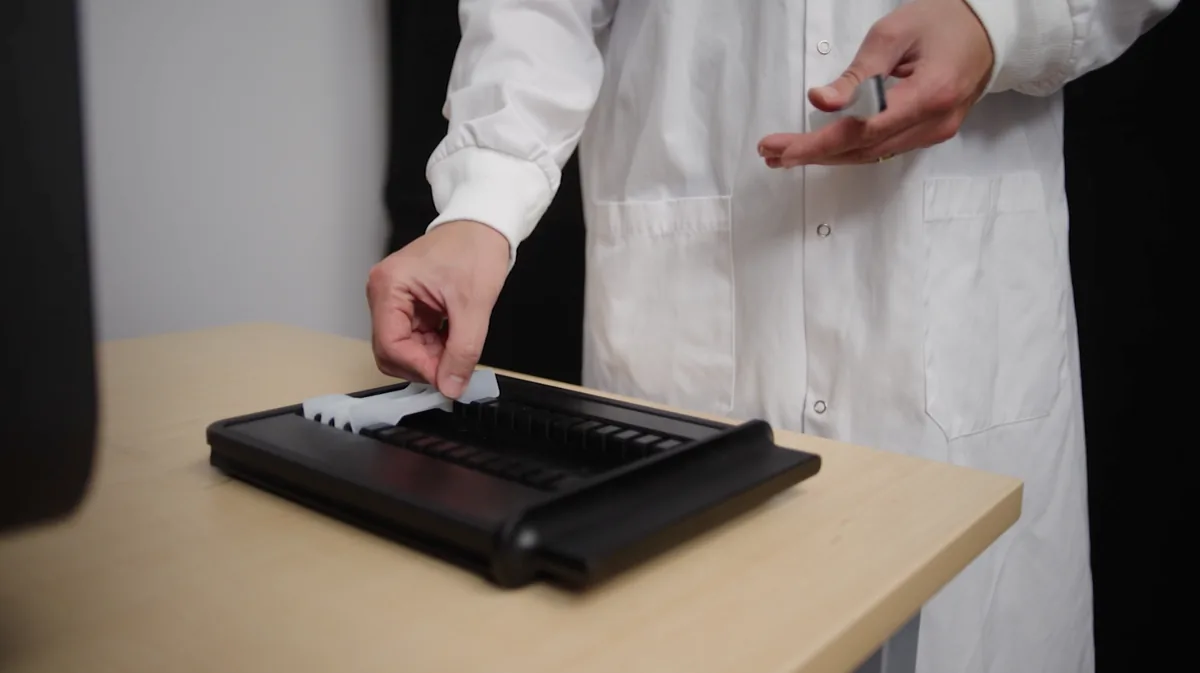
Load up to 15 tensile specimens at once — mix compounds and materials on the same tray.
Start the test
Enter compound names on the touchscreen and start the run with a single touch.
Review your data
When the run finishes, review results on the machine touchscreen, in your own system, or in the LabsCubed cloud.
The numbers that matter.
Lead with the outcomes, then check them against the full specification.
of technician testing time recovered for higher-value work.
more consistent results, proven by extensive studies.
tensile specimens loaded and tested in a single run.
CubeTen specification
Key features and performance criteria of the CubeTen.
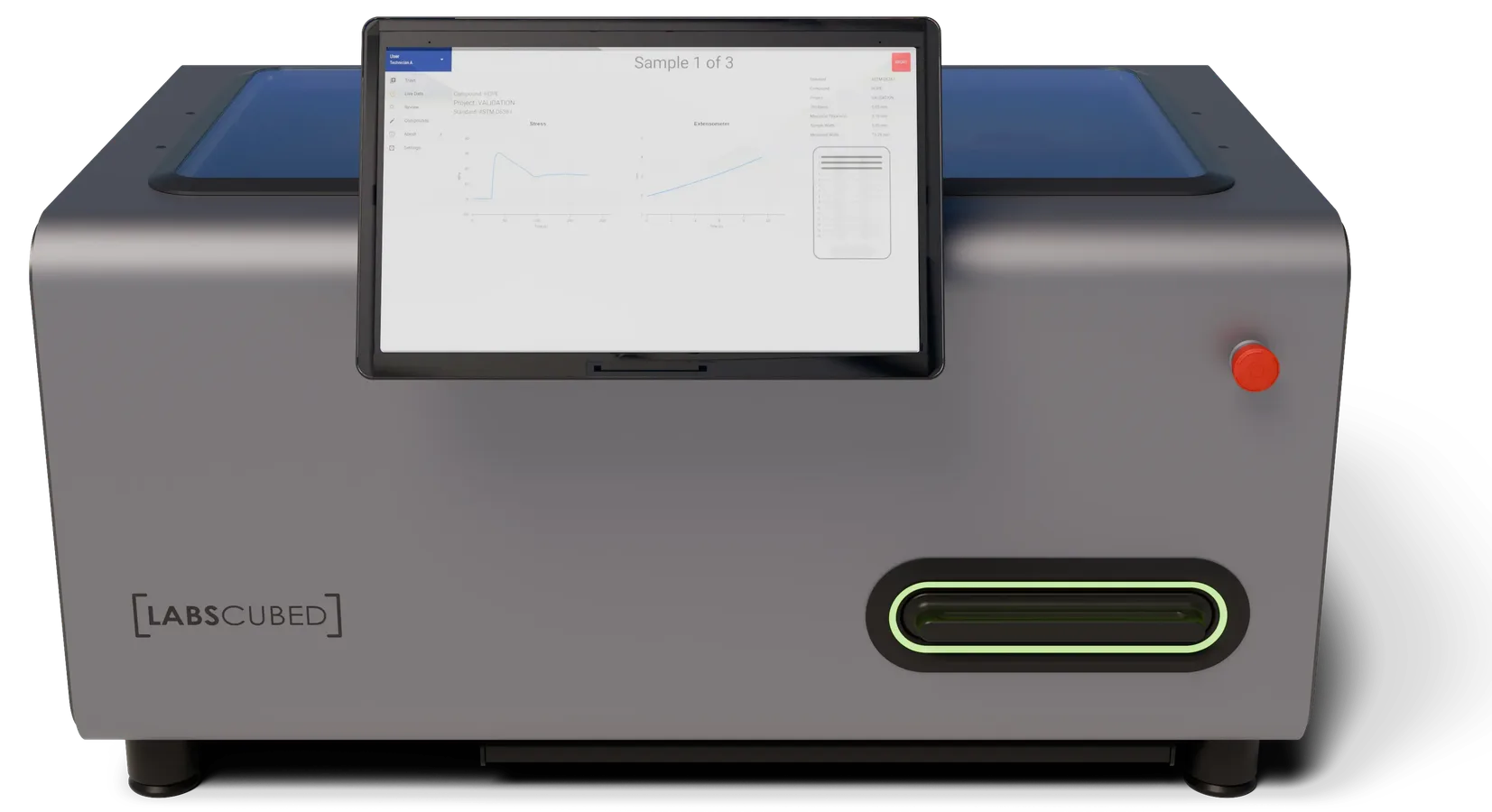
- Tensile standards
- ASTM D638 · ISO 527 · DIN · JIS
- Adhesive tests
- Single lap shear · T-peel
- Force (Omega Load Cell)
- Up to 10 kN
- Elongation
- Up to 1000%
- Sample capacity
- Up to 15 specimens per run
- Thickness & width
- Measured automatically
- Strain measurement
- Crosshead · physical or video extensometer
- Weight
- 250 lbs (115 kg)
Download the CubeTen brochure
Specs, supported standards and specimen types, and how the CubeTen automates plastic tensile testing, in one PDF. We'll email it to you.

How the CubeTen measures strain accurately
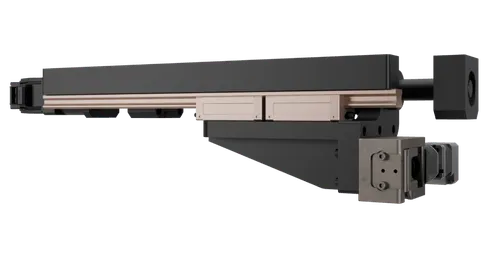
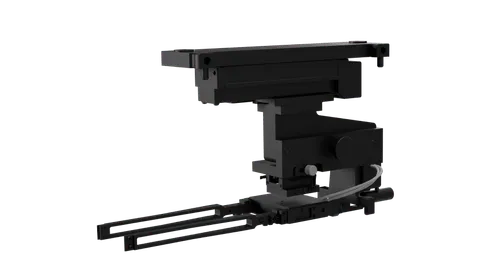
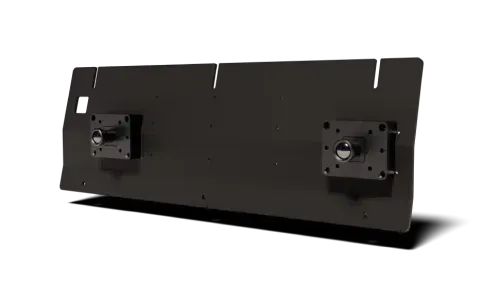
Every CubeTen pairs a built-in encoder with calibrated contact and non-contact extensometers, so each plastic is measured by the right method for the material.
Frequently asked questions
What is the CubeTen?
The CubeTen is LabsCubed's automated tensile testing machine for rigid plastics and adhesives. Load up to 15 specimens at once and it measures, grips and pulls each one unattended — with a force capacity of up to 10 kN and elongation up to 1000% — while your team moves on to higher-value work.
Which testing standards does the CubeTen support?
Tensile testing to ASTM D638 and ISO 527, as well as DIN and JIS methods. The same machine also runs adhesive tests such as Single Lap Shear and T-Peel without requiring any modifications.
Which ASTM D638 and ISO 527-2 specimen types can it test?
All five ASTM D638 geometries — Type I for rigid plastics, Type II for materials that won't break as a Type I, Type III for thick sections up to 14 mm, Type IV for thin plastics and comparisons of different rigidity, and Type V micro-tensile specimens — plus ISO 527-2 Type 1A multipurpose moulded and Type 1B machined specimens.
What types of plastics can the CubeTen test?
A wide range of polymers tested at ambient temperature, including PP, HDPE, PVC, ABS, Polycarbonate (PC), Nylon (PA), POM, PBT and TPU, as well as thermosets such as epoxy and phenolic resins.
Do I need an extensometer for ASTM D638?
An extensometer is required whenever modulus or strain values are reported. Crosshead displacement is acceptable for basic elongation checks, but it includes machine compliance and will overstate strain. The CubeTen supports crosshead displacement, an automated physical extensometer, and a video extensometer.
How does automation improve plastic tensile test repeatability?
Manual positioning, gauge marking and clamping are the main sources of test-to-test variation. The CubeTen measures width and thickness with calibrated sensors, auto-aligns each specimen in the grips and applies a consistent gripping force, so the operator is removed from the result — delivering up to 40% more consistent data.
Is the CubeTen right for my lab's testing volume?
The CubeTen is built for Lab Managers, Quality Directors and R&D Engineers at plastics compounders and processors with medium-to-high testing volumes — typically facilities running 10 or more plastic tensile tests per day.
What is the typical ROI for a CubeTen?
Most customers achieve a full return on investment in 18–24 months, driven by recovering up to 95% of technician testing time and by reducing costly scrap and rework through eliminating operator-induced variability.
How do I access and visualize my test data?
Every test delivers stress-strain curves, shear and peel data, and in-depth raw data for each specimen. Results can be reviewed on the machine's touchscreen or in the cloud-based LabsCubed Portal, and our software team integrates directly with your existing systems, including Alpha Workbench, Uncountable, SAP and other LIMS/ERP platforms.
What is the difference between the CubeTen and the CubeOne?
The CubeTen is engineered for rigid plastics and high-strength materials, with up to 10 kN of force and support for adhesive tests like Single Lap Shear and T-Peel. The CubeOne is built for rubber and elastomers, with up to 1 kN of force and optimized for high-elongation materials.
Does the horizontal design affect accuracy compared to vertical UTMs?
No. LabsCubed has 10 years of comparative test data showing that our horizontal orientation delivers results identical to traditional vertical machines. The design is what enables high-speed robotic loading, and each system is precision-calibrated so gravity and friction have no impact on load readings.
At what temperature does the CubeTen test?
The CubeTen is optimized for high-throughput testing at standard laboratory ambient temperatures. We do not currently support extreme high- or low-temperature testing, such as environmental chambers.
What does onboarding and support look like?
We offer a white-glove setup: a LabsCubed specialist performs on-site installation, calibration to ASTM standards and team training. After installation, we provide prompt remote support and annual on-site calibration services to keep your CubeTen at peak performance.
Ready to automate your plastics lab?
Get a tailored CubeTen quote for your testing standards and daily volume.