Plastics labs running manual ASTM D638 tests typically process 20–30 specimens per operator per day. Switch to a fully automated system, and that same lab can run 60–90 specimens — with fewer errors and no operator standing at the machine for hours.
That is the practical case for automated ASTM D638 testing. Not hype. Numbers.
more specimens per day, up to
Manual D638 testing tops out around 20–30 specimens per operator per day. A fully automated workflow can reach 60–90 by removing the operator from the repetitive loading loop entirely.
What manual ASTM D638 testing costs your lab
Every manual D638 test follows the same sequence: load a specimen, attach an extensometer, start the test, remove the failed specimen, log the data, repeat. It sounds manageable — until you are running high-volume QA for a production line, validating a new material grade, or supporting a regulatory submission with hundreds of specimens.
At that scale, manual testing creates real problems:
- Throughput bottlenecks — One skilled operator means one test at a time. Backlogs pile up fast during peak QA periods.
- Data variability — Hand-loading introduces grip alignment differences that show up as scatter in your tensile curves.
- Operator fatigue — Repetitive loading across an 8-hour shift increases the chance of misaligned specimens and skipped data entries.
- Headcount dependency — Adding people solves volume temporarily but does not fix the underlying process constraint.
For QA Directors at plastics compounders and R&D leads validating new formulations, these constraints slow product development cycles and delay quality releases.
What fully automated D638 testing looks like
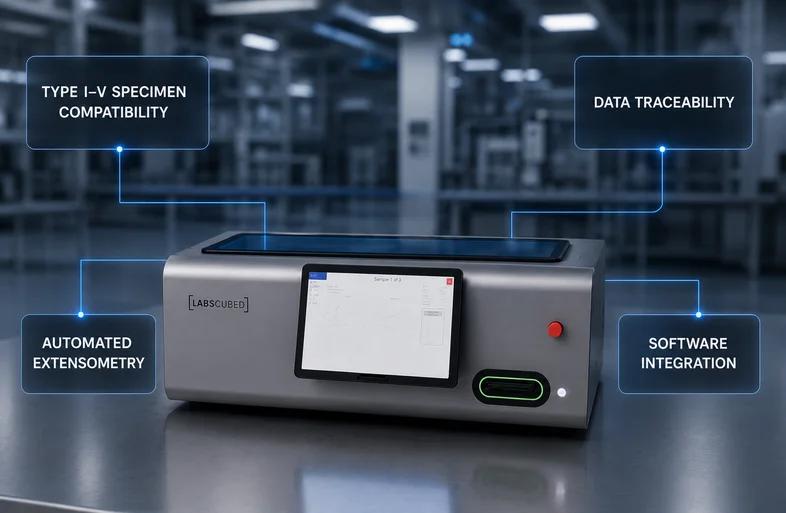
A fully automated ASTM D638 system does not just speed up one step — it removes the operator from the repetitive loop entirely.
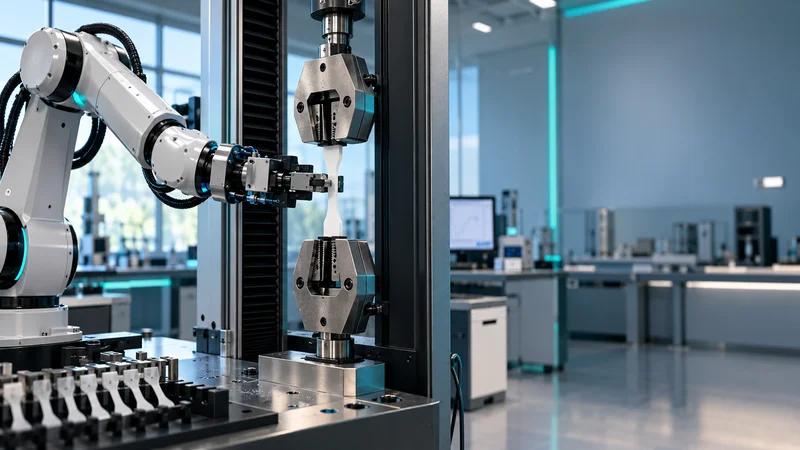
With the CubeTen robotic testing system, the entire workflow runs hands-free:
Queue
Specimens are queued in a tray, ready for unattended loading.
Load
The robot picks, orients, and loads each specimen into calibrated grips.
Measure
An automated extensometer attaches, measures, and detaches — no human contact required.
Route
Test data routes directly to your LIMS or QMS with no manual export step.
Repeat
Failed specimens are disposed automatically; the next test begins immediately.
The result: consistent grip alignment on every specimen, automated data capture with zero transcription errors, and continuous operation across shifts — including unattended overnight runs.
Key advantages over manual and semi-automated systems
Most legacy tensile testers offer limited automation — a self-locking grip here, a touch-panel interface there. That is semi-automation. Full robotic automation delivers a different class of results:
| Manual | Semi-automated | Recommended CubeOne / CubeTen | |
|---|---|---|---|
| Specimens per day | 20–30 | 30–50 | 60–90+ |
| Grip alignment | Operator-dependent | Operator-dependent | Consistent every run |
| Data entry | Manual log | Semi-automated | Fully automated |
| Overnight operation |
Overnight operation is the most underrated benefit. A system that runs unattended from 6 PM to 6 AM adds an entire extra shift — without additional labor cost.
What to look for in an automated D638 testing system
Not all automated systems are equal. When evaluating options, prioritize these capabilities:
- True hands-free specimen loading — The robot, not a manual jig, should handle specimen placement and removal on every cycle.
- Automated extensometer — Manual extensometer attachment is the most common bottleneck in semi-automated setups. Eliminate it entirely.
- LIMS/QMS integration — Test data should route directly to your existing systems without a manual export step.
- ASTM D638 Type I–V compatibility — Your system should handle the full range of specimen geometries you run in production.
- Documented throughput rates — Ask vendors for verified specimens-per-hour data at your specimen type and target crosshead speed.
For a deeper look at the D638 standard itself — specimen dimensions, grip types, and rate-of-separation requirements — see our full ASTM D638 testing guide.
Is your lab ready to automate?
The most common objection is volume: “We do not run enough specimens to justify it.”
That threshold is lower than most labs expect. At 30+ specimens per week, the time savings on specimen handling, data entry, and operator supervision alone typically offset the system investment within 12–18 months. For labs running 100+ specimens weekly, ROI often comes in under 6 months.
Our automation vs. manual testing white paper breaks down the math by specimen volume — a practical benchmark before you request a quote.
If your team spends more time standing at the machine than analyzing results, that is the clearest signal that D638 automation is worth a serious evaluation.
Frequently asked questions
How many ASTM D638 specimens can an automated system run per day?
Plastics labs running manual ASTM D638 tests typically process 20 to 30 specimens per operator per day. A fully automated system can run up to 60 to 90 specimens per day, with fewer errors and no operator standing at the machine for hours.
Does my lab run enough specimens to justify automation?
That threshold is lower than most labs expect. At 30 or more specimens per week, the time savings on specimen handling, data entry, and operator supervision typically offset the system investment within 12 to 18 months. For labs running 100 or more specimens weekly, return on investment often comes in under 6 months.
What should I look for in an automated D638 testing system?
Prioritize true hands-free specimen loading, an automated extensometer, LIMS or QMS integration, ASTM D638 Type I to V compatibility, and documented throughput rates verified at your specimen type and target crosshead speed.
Ready to see it run
The CubeTen handles ASTM D638 testing for plastics, rubber, and composite specimens — with full robotic specimen handling and automated extensometry.
Run up to 3x more D638 specimens per day
See how CubeTen automates ASTM D638 testing for plastics, rubber, and composites — from robotic specimen handling to automated extensometry.