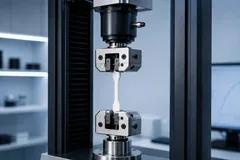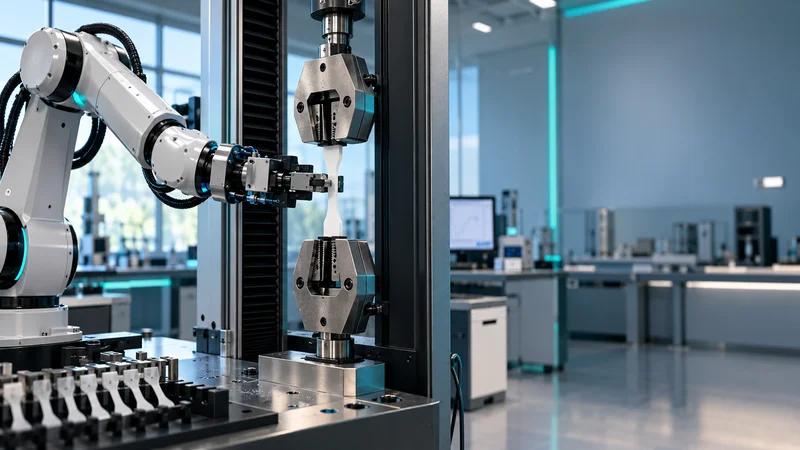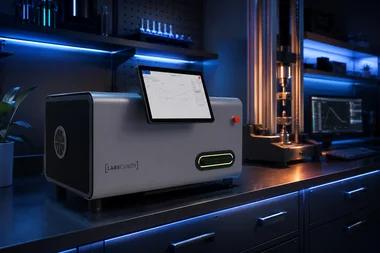
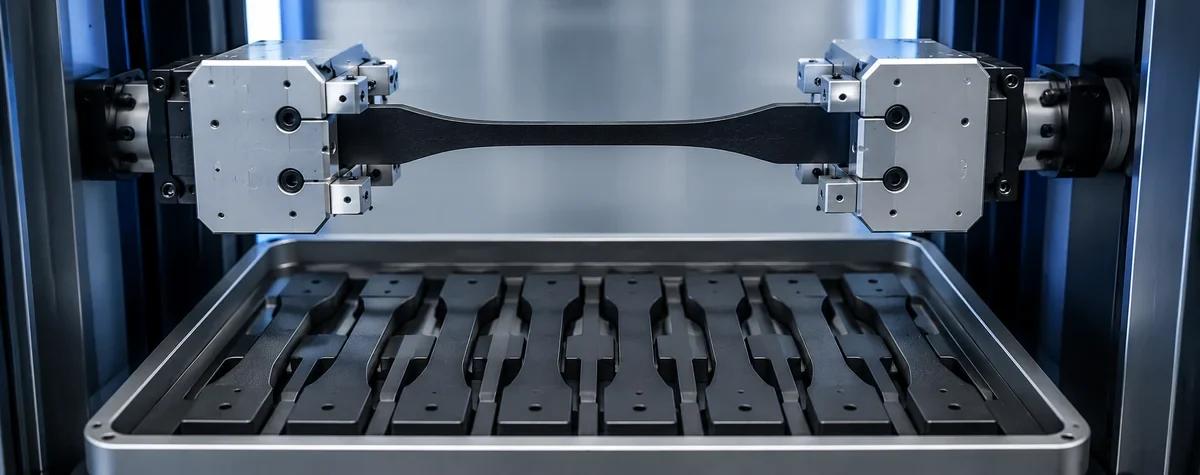
When a rubber testing lab falls behind, the problem is rarely the tensile test itself — it is the specimen loading, grip adjustments, and manual reporting that occur between cycles. An automated rubber tensile testing machine combines specimen handling, test execution, and data collection into one repeatable workflow, removing the manual steps that consume technician time and introduce operator variability. LabsCubed's CubeOne, CubeTen, and HERO Lab systems automate these processes while supporting ASTM D412 and ISO 37 rubber testing requirements.
What does a rubber tensile testing machine measure?
A rubber tensile testing machine measures how elastomer materials respond to tensile forces by generating stress-strain data throughout the test.
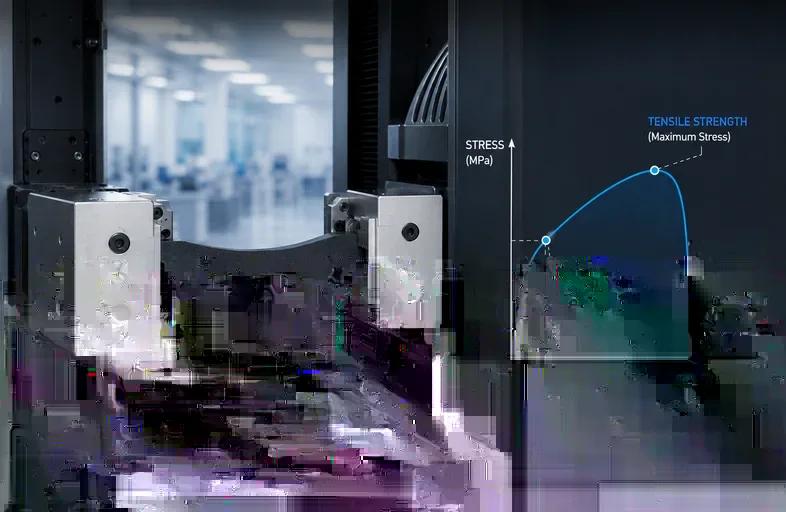
The resulting stress-strain curve is used to determine:
- Tensile strength
- Elongation at break
- Modulus at specific elongation levels
- Material stiffness and deformation behavior
These properties are critical for qualifying compounds used in:
- Seals
- Gaskets
- Hoses
- Tires
- Industrial elastomer components
Most industrial rubber testing programs rely on ASTM D412 and ISO 37 as the primary standards for evaluating tensile performance.
Why do manual rubber testing workflows create bottlenecks?
Manual workflows often limit throughput and introduce variability that can affect test consistency.
A typical technician may spend more time handling specimens than running the actual test. Common manual tasks include:
- Loading dumbbell specimens
- Adjusting grip force
- Verifying specimen alignment
- Recording results
- Managing traceability records
As sample volumes increase, these activities become a growing source of delay. Manual workflows can also introduce:
- Operator variability
- Specimen slippage
- Inconsistent grip seating
- Data entry errors
- Retests caused by handling issues
For laboratories running ASTM D412 testing throughout the day, reducing these sources of variation can have a significant impact on repeatability.
What specifications matter when selecting a rubber tensile testing machine?
The right system should be optimized for elastomer testing rather than adapted from a general-purpose platform. Four criteria carry most of the decision.
Load cell performance
Rubber testing often requires accurate force measurement at relatively low loads. Verify performance within your actual testing range rather than relying solely on rated capacity.
Crosshead speed control
ASTM D412 and ISO 37 require controlled test speeds. Maintaining a consistent crosshead speed throughout the test is essential for generating repeatable stress-strain data.
Grip design
Grip selection has a direct impact on data quality. Pneumatic grips are often preferred because they provide consistent clamping force and reduce the risk of specimen slippage.
Data management
Modern systems should support automatic data capture, traceability, audit trails, real-time reporting, and LIMS and QMS integration — eliminating manual transcription and improving reporting efficiency.
ASTM D412 and ISO 37 requirements
ASTM D412 and ISO 37 establish standardized procedures for measuring tensile properties of vulcanized rubber and thermoplastic elastomers.
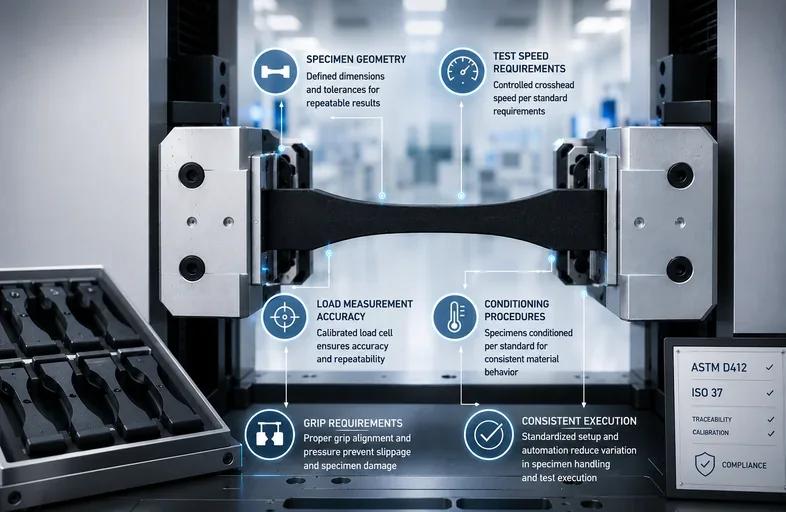
The standards define:
- Specimen geometry
- Test speed requirements
- Load measurement accuracy
- Conditioning procedures
- Grip requirements
Consistent execution of these procedures is essential for producing results that can be compared across laboratories and production sites. Automation helps support compliance by reducing variation introduced during specimen handling and setup. For a step-by-step walkthrough, see our guide on how to run ASTM D412 and ISO 37 tensile testing for rubber.
Manual vs. automated rubber testing
The primary benefit is consistency. When specimen handling, grip seating, and reporting are standardized, laboratories can focus on analyzing results rather than managing repetitive tasks.
| Manual workflow | Recommended Automated workflow | |
|---|---|---|
| Specimen loading | Manual specimen loading | Robotic specimen handling |
| Alignment | Visual alignment | Consistent positioning |
| Reporting | Manual reporting | Automated data capture |
| Setup | Operator-dependent setup | Improved repeatability |
| Traceability | Manual traceability | Digital audit trails |
| Utilization | Limited utilization | Continuous operation |
See why manual tensile testing can cost your lab significant time compared with an automated workflow.
How LabsCubed approaches rubber testing automation
LabsCubed treats automation as a complete workflow rather than a machine feature. CubeOne and CubeTen integrate:
- Robotic specimen handling
- AI-powered vision
- Specimen validation
- Grip seating verification
- Automated data collection
- Digital audit-ready records
Within the HERO Lab ecosystem, these systems help connect specimen preparation, tensile testing, and reporting into a single workflow. For laboratories running high volumes of ASTM D412 or ISO 37 testing, this approach helps improve repeatability while reducing operator dependency. For the tensile-specific view, see our automated tensile testing guide.
Frequently asked questions
What is an automated rubber tensile testing machine?
An automated rubber tensile testing machine combines robotic specimen handling, tensile testing equipment, and software to automate testing and reporting workflows.
Which standards are used for rubber tensile testing?
ASTM D412 and ISO 37 are the most widely used standards for measuring tensile properties of rubber and elastomers.
How does automation improve rubber testing?
Automation helps reduce operator variability, improve repeatability, and automate data collection and traceability.
Conclusion
As testing volumes increase, manual workflows become more difficult to scale. Automated rubber tensile testing machines help laboratories improve repeatability, reduce operator variability, and maintain data traceability by automating specimen handling and reporting. By combining robotics, AI-powered vision, and workflow automation, LabsCubed's CubeOne, CubeTen, and HERO Lab platforms help rubber manufacturers create more consistent and efficient quality control processes.
Automate your rubber testing workflow
Looking to automate your ASTM D412 or ISO 37 testing? Talk with the LabsCubed team to explore how CubeOne, CubeTen, and HERO Lab can support your rubber testing requirements.