If your QA lab runs dozens of tensile or flexural tests each week, you already know the bottleneck: skilled technicians spending hours on repetitive specimen prep, grip alignment, and data entry — work that adds cost without adding insight. Lab automation robotics changes that equation. Robotic systems now handle every step from specimen loading to data export, letting your team focus on the decisions that actually require human judgment.
This guide covers what lab automation robotics means for materials testing specifically — not pharma, not biotech — and what QA Directors, Plant Managers, and R&D leads in plastics and rubber manufacturing need to know before evaluating systems.
What Is Lab Automation Robotics?
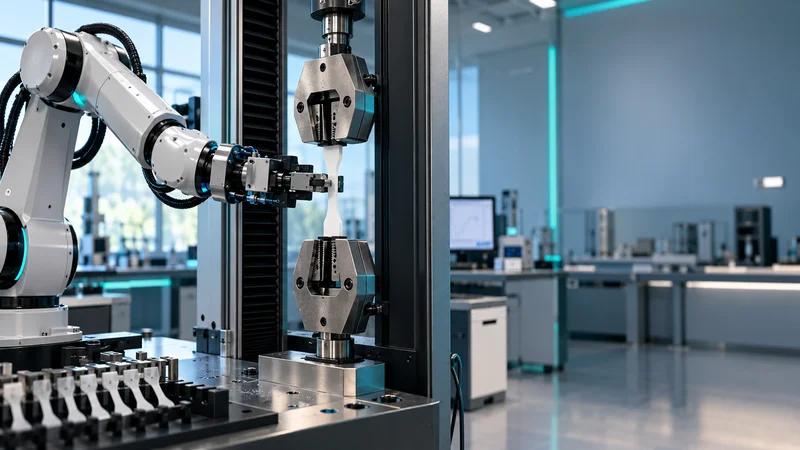
Lab automation robotics is the integration of robotic arms, motion systems, and software into laboratory workflows to execute tasks with precision and repeatability. In a materials testing environment, that means a robotic system that can:
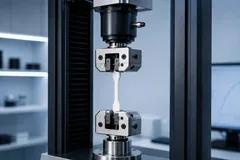
- Load specimens into a tensile frame without manual handling
- Align grips consistently across hundreds of tests
- Trigger test sequences, capture force-displacement data, and export results automatically
- Log timestamps, batch IDs, and test conditions to a centralized data system
The distinction from traditional automation — like a motorized test frame — is that robotic systems are programmable and flexible. They can switch between test types, handle different specimen geometries, and integrate with your LIMS or ERP without manual reconfiguration between runs.
Why Traditional Materials Testing Struggles to Scale
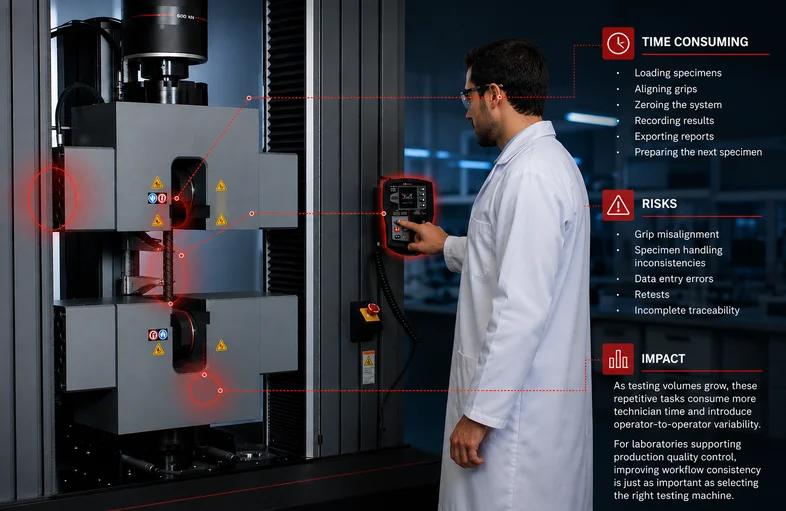
Manual materials testing works — until volume increases, regulations tighten, or staffing becomes unpredictable. The core problem is not that your team is doing anything wrong. Human performance naturally varies between shifts, operators, and stress levels. In ASTM-governed tests like D638 or D412, even small differences in grip placement or crosshead speed startup can shift results by several percent.
Three pain points consistently drive QA labs toward robotic automation:
- Throughput walls — A skilled technician can realistically run 20–30 tensile tests per shift. A robotic system runs significantly more with no quality degradation between test one and test two hundred.
- Operator-to-operator variability — Grip torque, specimen centering, and load cell zeroing all introduce variability when done manually. Robots repeat the same action within microns every time.
- Audit trail gaps — Manual data entry creates opportunities for transcription errors and incomplete records. Automated systems timestamp and log every test event automatically — which matters when a customer or regulator asks you to prove your process.
If you are assessing whether automation makes sense, start by understanding how tensile data collection bottlenecks compound over time — the hidden labor cost is usually larger than it first appears.
Manual vs. Automated Materials Testing: A Side-by-Side Look
The economics depend on your test volume, material types, and regulatory requirements. Here is how the two approaches compare across the factors that matter most to QA operations:
| Manual testing | Recommended CubeOne / CubeTen | |
|---|---|---|
| Throughput per shift | 20–30 tests | 100+ tests (varies by test type) |
| Grip consistency | Operator-dependent | Programmed, repeatable to ±0.1 mm |
| Data logging | Manual entry; error-prone | Automatic timestamping and export |
| ASTM compliance audit trail | Incomplete; relies on manual notes | Full, automated, searchable log |
| Operator skill requirement | High — affects result quality | Lower — robot handles execution |
| Cost per test at scale | Increases with volume | Decreases as volume grows |
| Night and weekend operation | Requires staffing | Lights-out capable |
The cost-per-test argument deserves emphasis. At low volumes, manual testing is cheaper. The economics typically shift somewhere between 50 and 200 tests per week depending on your labor rate and test complexity. Above that threshold, robotic automation usually pays for itself in under two years.
Which Materials Tests Are Best Suited to Robotic Automation?
Not every materials test is equally automatable. The highest ROI comes from tests that are high-volume, standardized by ASTM or ISO, and sensitive to operator variability. For plastics and rubber labs, the strongest candidates are:
- ASTM D638 / ISO 527 — Tensile properties of plastics. High volume, standardized dumbbell specimens, grip-sensitive. A natural fit for robotic specimen handling.
- ASTM D412 — Tensile properties of vulcanized rubber. Dogbone specimens with defined gauge length — precise robot loading eliminates grip inconsistency.
- ASTM D790 / ISO 178 — Flexural properties. Three-point bend setup benefits from consistent span alignment that robots deliver every test.
- ASTM D882 — Tensile properties of thin plastic film. Delicate specimens that benefit from controlled, gentle robotic grip application.
If your lab runs any of these methods manually at volume, robotic automation is likely cost-justified. For a grounding in what these tests measure before evaluating automation, see what tensile testing is and why it matters for materials QA labs.
How LabsCubed Applies Lab Automation Robotics to Materials Testing
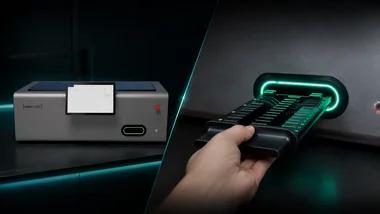
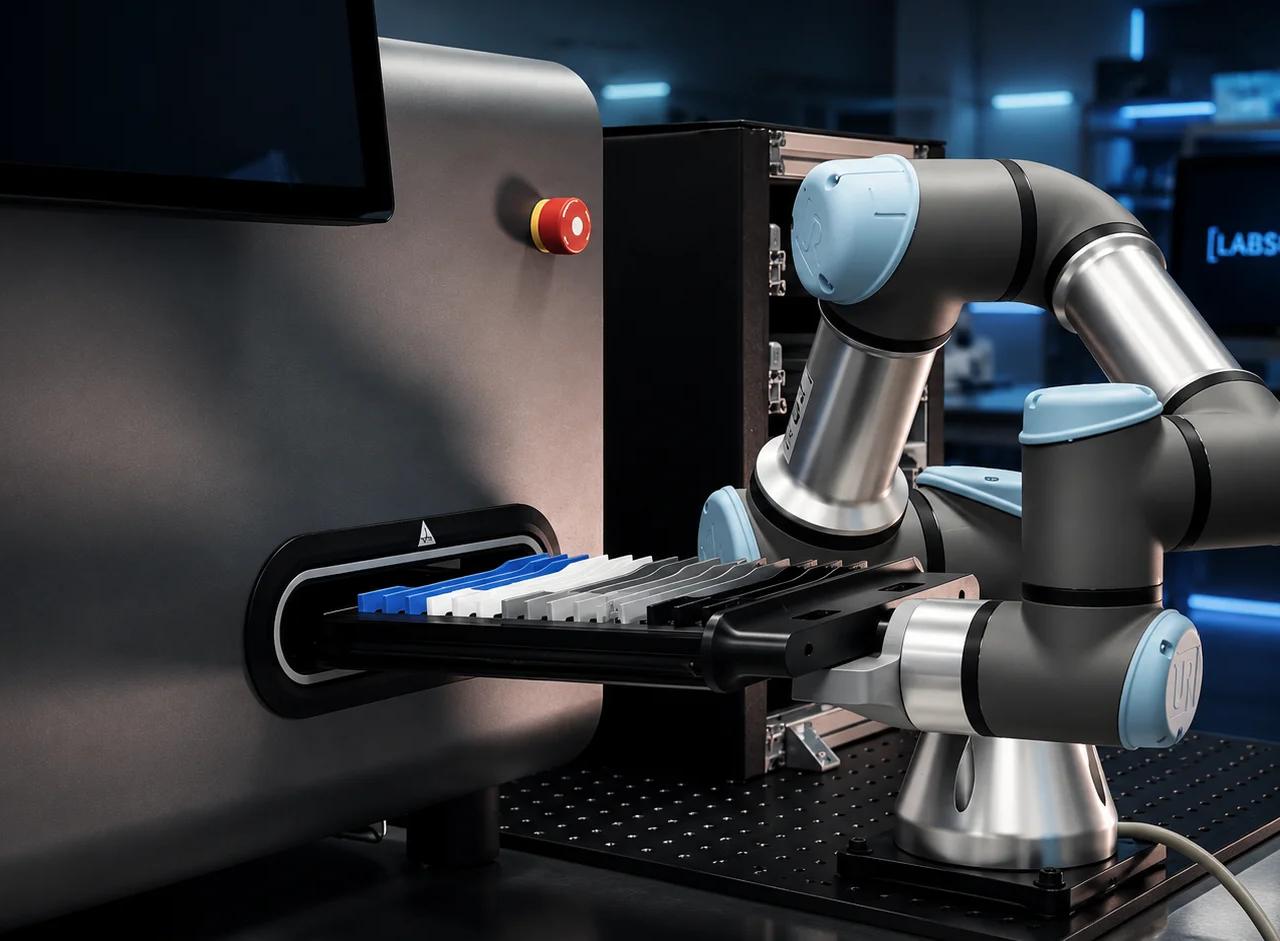
LabsCubed builds robotic testing systems specifically for plastics, rubber, and composites labs — not repurposed pharma automation. CubeTen for plastics and CubeOne for rubber integrate a robotic arm with a standard tensile frame, specimen magazine, and software layer that handles the full test workflow from specimen pickup through result export.
In practice, that workflow runs as a continuous loop:
Load
Specimens load from a cassette — no operator required between tests.
Align
Grip alignment is programmatic, not operator-adjusted each run.
Test
The test runs to your ASTM or ISO method, capturing force-displacement data automatically.
Log
Every test event is timestamped and logged, producing a complete audit trail for compliance reviews.
Export
Results export directly to your data system — no transcription step between the machine and your records.
The system is designed around existing ASTM test methods, not new workflows. Labs do not retrain teams on new procedures; they reallocate technician time from running tests to reviewing results — where materials expertise has the most leverage.
Ready to see how it fits your testing program? Join the CubeGo waitlist and our team will evaluate your test volume and specimen types directly.
What to Look for When Evaluating Lab Automation Robotic Systems
Not all robotic lab automation platforms are designed for materials testing. When evaluating systems, prioritize:
- Specimen compatibility — Does it handle your specific geometries: dumbbells, dog bones, thin films, flex bars, or round specimens?
- Standards alignment — Is the system validated against the ASTM or ISO methods you report against, or will you need to validate it yourself?
- Data integration — Can results feed directly into your LIMS, ERP, or cloud storage without a manual export step?
- Audit trail capability — Does the system log every test event automatically and make that log retrievable for customer or regulatory review?
- Scalability — Can you add test types or increase throughput as production volume grows, without replacing the core system?
Avoid systems that require extensive custom programming to change between test methods. In a QA lab running multiple material families and product lines, flexibility matters as much as raw throughput.
Frequently Asked Questions
What is lab automation robotics?
Lab automation robotics is the use of robotic systems and software to perform repetitive laboratory tasks — including specimen handling, test execution, and data collection — with minimal human intervention. In materials testing environments, robotic automation replaces manual gripping, alignment, and result logging with consistent, programmable workflows that repeat exactly the same way on every test, every shift.
How does robotic automation improve accuracy in materials testing?
Robotic automation eliminates the most common source of variability in materials testing: human execution differences between operators and shifts. When a robot loads specimens and aligns grips with the same programmed parameters every test, results reflect the actual material properties — not technician variation. Labs using automated systems typically see significantly tighter standard deviation across repeat tests and far fewer data transcription errors compared to manual workflows.
Which ASTM tests can be automated in a plastics or rubber testing lab?
Several high-volume ASTM methods are well-suited to robotic automation, including ASTM D638 (tensile properties of plastics), ASTM D412 (tensile properties of rubber), ASTM D790 (flexural properties), and ASTM D882 (thin plastic film tensile). Automated systems like the LabsCubed CubeTen and CubeOne handle specimen loading, grip alignment, test execution, and data export for these methods — at throughput levels a manual lab cannot sustain over a full shift without fatigue-related variability.
Ready to give your QA team its time back?
Book a walkthrough of CubeTen for plastics and CubeOne for rubber. We'll evaluate your test volume, specimen types, and standards directly.