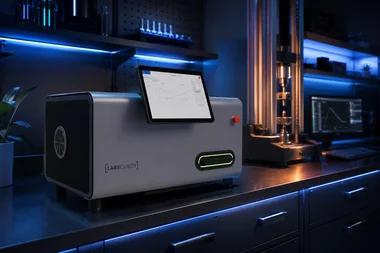
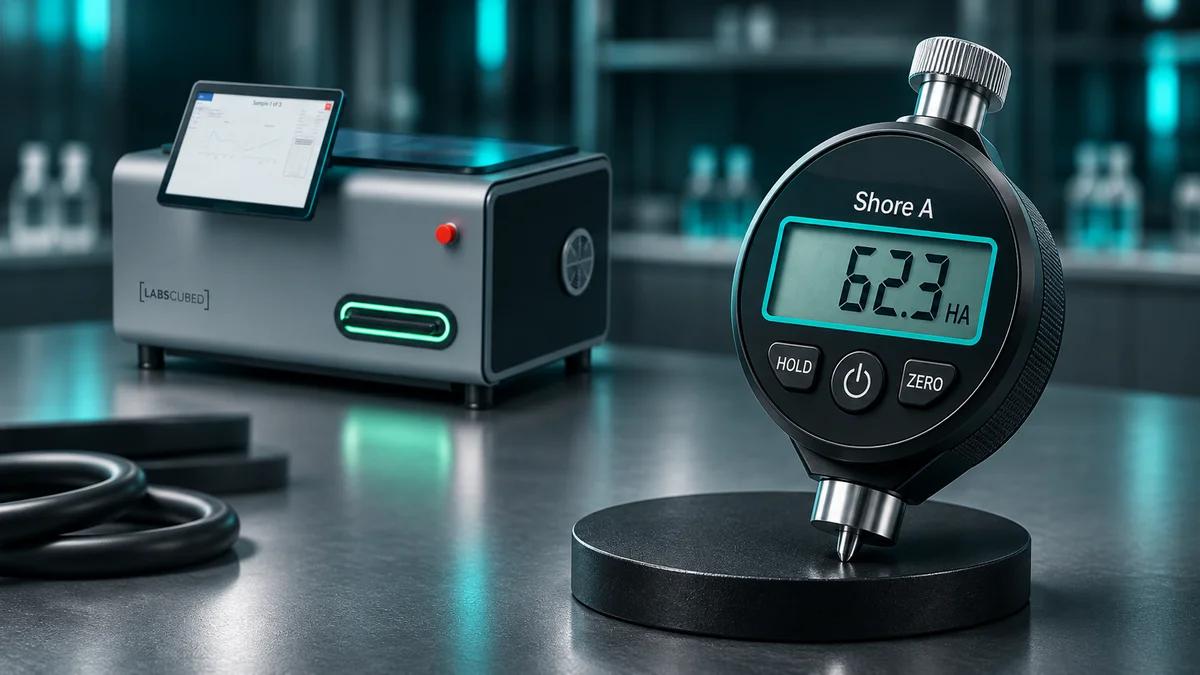
Elastomer hardness is a material's resistance to indentation, reported on a named scale rather than in engineering units — most often Shore A (ASTM D2240) or IRHD (ISO 48-2). Most commercial rubber compounds fall between 20 and 90 Shore A. LabsCubed builds the robotic testing systems — CubeOne and CubeTen — that QA labs use to verify those compounds.
What is elastomer hardness?
Elastomer hardness is the resistance of a rubber compound to a defined indenter pressed in under a defined force. It is dimensionless: the result is a number plus the scale that produced it — 70 Shore A, 65 IRHD — and the scale is part of the answer, never a footnote.
Hardness is not a property of the polymer but a formulation outcome, set by filler loading, plasticiser content and degree of cure. The same nitrile family runs from soft gasket stock to hard bushing grade. That is why hardness alone never qualifies a lot: it confirms a compound is what it was last time, not that it will perform.
What hardness does give you is speed. A durometer reading takes seconds and needs no specimen preparation, which makes it the natural first check on incoming material and on parts coming off a press. Across most rubber testing workflows it functions as a process-control indicator: a shift flags that something upstream has changed, and the slower mechanical tests explain what.
Shore A or IRHD — which scale should you use?
Use Shore A (ASTM D2240, ISO 48-4) for flat specimens and general QA; use IRHD (ISO 48-2) for finished parts, curved surfaces and thin sections. They are separate systems: Shore A drives a truncated cone with a calibrated spring, while IRHD presses a rigid ball under a dead load and measures the differential indentation.
The numbers land close on most compounds — near enough that they are often quoted interchangeably — but they are not the same measurement, and the agreement degrades at the soft and hard ends of the range. If a drawing calls out IRHD, a Shore A reading is not a substitute, and vice versa.
Two variants matter in practice. Micro-IRHD (IRHD-M) handles specimens too thin or small for the standard method, such as O-ring cross-sections; Type M durometers do the same job on the Shore side. Where a part cannot meet the standard's specimen requirements, the honest answer is a micro method or a moulded slab from the same batch.
Outside the Shore A window, the scale changes again: below roughly 20 Shore A, readings crowd at the bottom of the scale and Shore OO is the better instrument; above roughly 90 Shore A, the scale saturates and Shore D takes over.
How hard are common elastomers?
Most commercial elastomers are supplied between 30 and 90 Shore A, with 60–70 Shore A the single most-specified band across sealing and gasket applications. The ranges below are indicative for specification discussions, not substitutes for a supplier datasheet or a tested lot certificate.
| Elastomer | Typical range | Where hardness usually lands |
|---|---|---|
| Silicone (VMQ) | 20–80 Shore A | Soft seals and medical tubing at the low end; keypads and gaskets mid-range |
| EPDM | 30–90 Shore A | Weather seal and roofing membrane at 50–70; bushings and pads above |
| Nitrile (NBR) | 40–90 Shore A | O-rings and fuel-system seals, most commonly 70 |
| Neoprene (CR) | 40–80 Shore A | General-purpose sheet and weather-resistant gaskets |
| Natural rubber (NR) | 30–90 Shore A | Anti-vibration mounts, couplings, wear linings |
| Fluoroelastomer (FKM) | 60–90 Shore A | High-temperature and chemical seals, typically 75 |
| TPE / TPU | Shore OO to Shore D | Spans the widest range of any family — always confirm the scale |
Notice how heavily these overlap. A 60 Shore A neoprene and a 60 Shore A EPDM feel identical in the hand and pass the same durometer check, yet they tolerate completely different fluids. Hardness cannot identify a material — only chemical and thermal resistance data can.
What does 50A durometer mean?
50A means a reading of 50 on the Shore A scale — a soft, flexible rubber that compresses easily under thumb pressure. The "A" is the scale, not a grade or a quality rating. The same material would read a very different number on Shore D or Shore OO, which is why the letter must always travel with the number.
In practice, 50A sits in the soft-seal band: low closure force, good conformability to imperfect sealing surfaces, and more compression set risk under sustained load than a 70A compound. It is a common choice where a seal has to take up tolerance rather than hold pressure.
Is a 70 durometer harder than 90?
No — on the same scale, 90 is harder than 70. Durometer scales run 0 to 100, with higher numbers meaning greater resistance to indentation. A 70 Shore A compound is a typical O-ring rubber; a 90 Shore A compound is noticeably stiffer and closer to a rigid bushing.
The comparison only holds within one scale. A 90 Shore OO material is much softer than a 70 Shore A one, because Shore OO covers gels and foams. Comparing bare numbers across scales is the single most common source of specification error in elastomer sourcing, and no conversion chart fixes it: published conversions are approximations built from specific material sets and carry error no downstream calculation can remove.
Why do elastomer hardness readings vary between operators?
Because four variables in a manual durometer check are uninstrumented: how fast the foot is applied, how much hand pressure is behind it, exactly when the number is read, and where on the specimen the indenter lands. None are recorded, so the resulting scatter looks like material variation when it is really technique variation.
Elastomers are especially exposed to the timing variable. Filled rubber creeps under the indenter, so the needle drifts downward after contact. An operator reading at one second and an operator reading at three will disagree by a few points on the same sheet, consistently, and both will believe they are right. Across a shift change that shows up in the control chart as a step that has nothing to do with the compound.
ASTM D2240 exists to close those gaps: a specimen at least 6 mm thick (stacking limited to three plies), indentations at least 12 mm from any edge, the reading taken at one second unless the specification says otherwise, five readings with the median reported, all at 23 ± 2 °C. Every one of those clauses exists because someone once got a wrong answer without it.
The practical point: before arguing whether a lot is 68 or 72 Shore A, check whether your measurement process can resolve that difference at all. With a ±5-point tolerance and uncontrolled dwell time, it usually cannot — and that is a workflow problem, not a materials problem.
Manual vs. automated elastomer testing
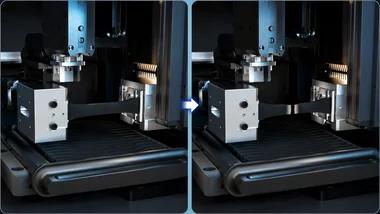
Automation does not make a durometer more accurate in principle. It changes everything around the measurement: specimen handling, timing, sequencing and the record. The same logic applies to the tensile and compression tests that actually qualify a compound, which is where automated systems earn their place.
| Manual bench workflow | Recommended CubeOne / CubeTen |
|
|---|---|---|
| Timing and dwell | Judged by eye, rarely timed or logged | Fixed to the method and recorded per specimen |
| Specimen alignment | Hand-placed; grip and indenter position vary | Robotic placement to programmed coordinates |
| Operator-to-operator drift | The dominant source of scatter | Removed from the controlled steps |
| Tensile follow-up | Separate session, often days later | Same queue, unattended, typically overnight |
| Data capture | Transcribed by hand, re-keyed into the LIMS | Written directly to the record at test time |
| Audit trail | Final result only | Specimen ID, parameters, curve, timestamp, operator |
| Throughput | Bounded by technician availability | Bounded by the queue, not the shift |
The gain that matters to a rubber QA lead is rarely speed on a single test. It is that a batch can be loaded once and run with identical parameters applied to every specimen, so month-over-month trend data is comparable. We set that case out in more depth in our guides to the automated rubber tensile testing machine and to lab automation robotics for plastics and rubber QA teams.
Hardness is also where a QA workflow branches. The durometer answers "has this compound changed?"; it cannot answer "will this seal hold?". That belongs to tensile strength, elongation and modulus under ASTM D412 and ISO 37, to compression set for parts under sustained load, and to the wider methods covered in our polymer mechanical testing guide. If you are choosing the frame that runs them, the universal testing machine buyer guide for rubber covers grips and force ranges.
Common mistakes when specifying elastomer hardness
Most hardness disputes trace back to a handful of avoidable errors:
- A number without a scale or method. "70 durometer" is ambiguous; "70 Shore A per ASTM D2240" is actionable.
- Ignoring the ±5-point tolerance. ASTM D2000 callouts move in five-point increments; rejecting a lot over three points is rejecting measurement noise.
- Testing a part the standard cannot measure. Thin, curved or ribbed sections fail the 6 mm thickness and 12 mm edge rules — use micro-IRHD or a moulded slab.
- Taking a single reading. The method calls for five and a median; one reading on a filled compound is a data point, not a result.
- Treating hardness as a strength or sealing proxy. A harder compound is stiffer, not stronger, and often lower in elongation. Compression set and ageing still have to be run.
- Comparing readings at different temperatures. Without equilibration to 23 ± 2 °C, a few points of apparent drift are the room, not the rubber.
Frequently asked questions
What is elastomer hardness?
Elastomer hardness is a rubber compound's resistance to indentation by a defined indenter under a defined force, reported on a named scale such as Shore A (ASTM D2240) or IRHD (ISO 48-2). It is dimensionless, so the scale must always be quoted with the number. Most commercial elastomers fall between 20 and 90 Shore A.
Is a 70 durometer harder than 90?
No. On the same scale, higher means harder, so 90 is harder than 70. The comparison only holds within one scale: a 90 Shore OO material is far softer than a 70 Shore A one, because Shore OO covers gels and foams. Always confirm the scale before comparing two durometer numbers.
What does 50A durometer mean?
50A means a reading of 50 on the Shore A scale — a soft, flexible rubber that compresses easily under thumb pressure. The letter is the scale, not a grade. A 50A compound conforms well to imperfect sealing faces but carries more compression set risk under sustained load than a 70A compound.
What is 40 durometer rubber?
40 durometer usually means 40 Shore A: a soft grade used where a seal must take up tolerance or seal against a rough surface at low closure force. It deflects noticeably under light pressure. Below about 20 Shore A the reading crowds the bottom of the scale and Shore OO becomes the appropriate instrument.
Is thermoplastic elastomer hard or soft?
Both. TPEs span the widest hardness range of any elastomer family, from gel-like grades measured on Shore OO through flexible Shore A compounds up to rigid grades read on Shore D. Because of that spread, a TPE specification is meaningless without the scale attached to the number.
Does higher hardness mean a better seal?
No. Harder compounds resist extrusion at higher pressures but conform less well to surface imperfections and need more closure force. Sealing performance depends on compression set, resilience, chemical compatibility and gland design as much as hardness. Hardness is a process-control indicator, not a performance prediction.
Is your hardness data telling you about the compound or the technician?
Talk to LabsCubed about running rubber hardness and tensile testing as one automated, auditable workflow with CubeOne or CubeTen.