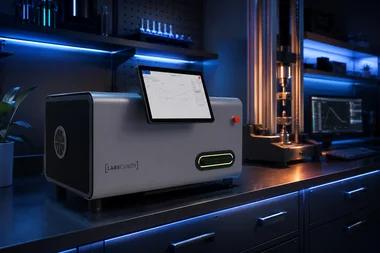
Polymer mechanical testing measures how plastics and rubber respond to applied stress — tension, compression, flexure, and impact — against standardized test methods like ASTM D638 and ISO 527. Labs use these results to confirm materials meet spec before they reach production. At LabsCubed, we work alongside QA teams who run hundreds of these tests per week, and our CubeTen system automates the plastics workflow end-to-end. Here is what you need to know about the methods, the standards, and where automation changes the outcome.
What Is Polymer Mechanical Testing?
Polymer mechanical testing is the set of laboratory procedures used to measure how plastic and rubber materials behave under controlled mechanical loads. The tests apply force — tension, compression, bending, or impact — and record how the material deforms, where it yields, and at what point it breaks.
Results feed into material selection decisions, supplier qualification, product design validation, and regulatory compliance. For a plastics manufacturer, a batch that fails tensile strength spec should never reach the production line. For a rubber compounder, elongation-at-break data directly predicts how the final part performs in the field.
Every major industry that uses polymers — automotive, medical devices, consumer packaging, aerospace — relies on mechanical test data to make or reject materials. The quality of that data depends on the test method, the lab environment, and increasingly, the degree to which testing has been automated to remove operator influence.
What Types of Tests Are Used in Polymer Mechanical Testing?
The four core test families cover the full range of mechanical stress a polymer is likely to see in service. Each maps to specific ASTM and ISO standards.
What is tensile testing for polymers?
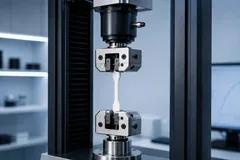
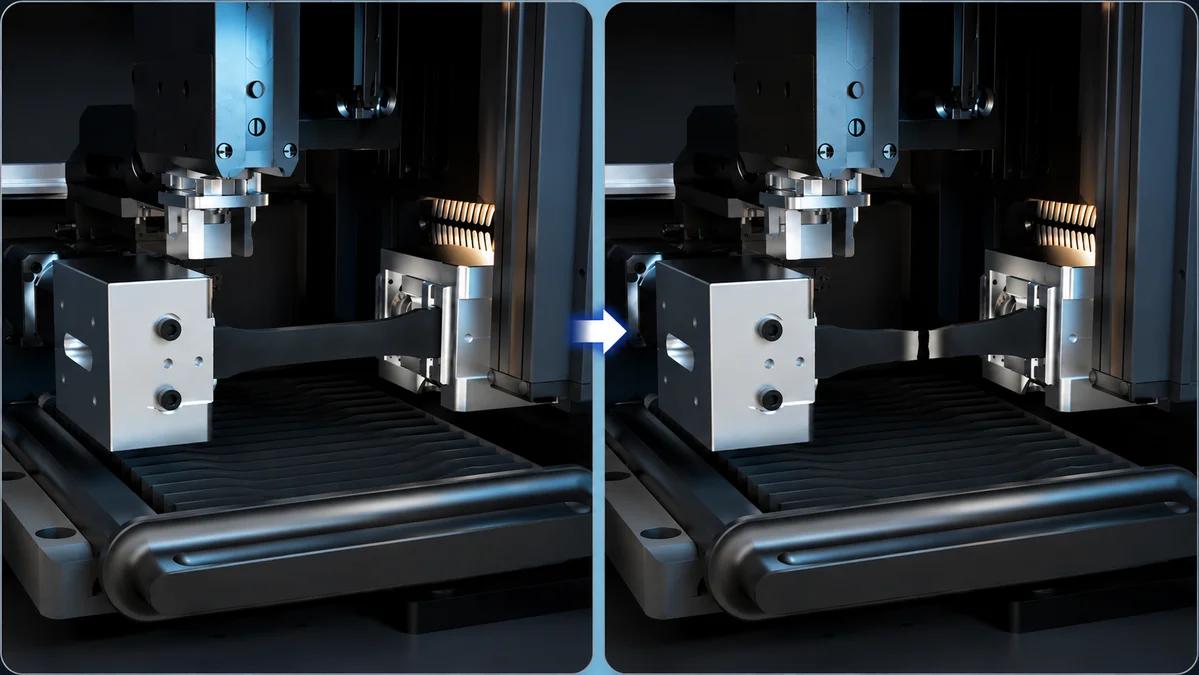
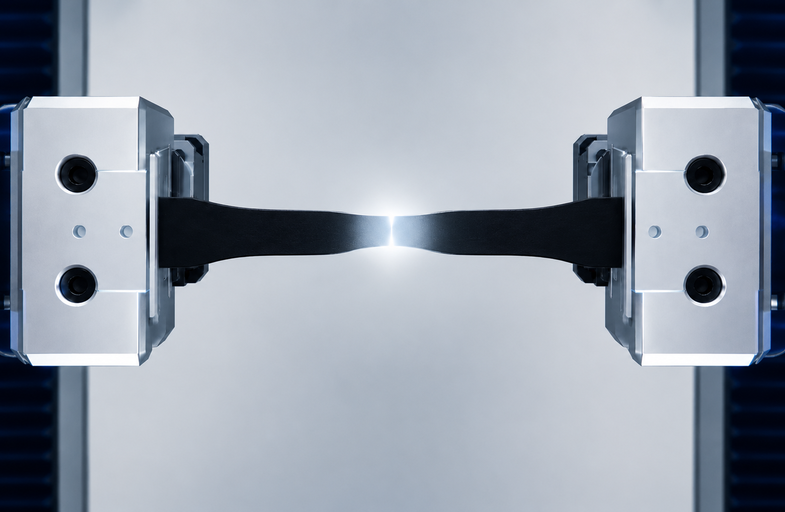
Tensile testing pulls a dumbbell-shaped specimen along its long axis until it breaks. It produces tensile strength, yield strength, elongation at break, and Young's modulus in a single run. For plastics testing, ASTM D638 and ISO 527 are the governing standards. For rubber, ASTM D412 and ISO 37 apply. Tensile testing is the most common single test in polymer QA because the data is comprehensive and directly tied to end-use performance.
Crosshead speed is a key variable: stiffer materials typically test at 5 mm/min, while soft elastomers may require 500 mm/min. Running the wrong speed is one of the most common testing errors (more on this below).
See: ASTM D638 / ISO 527 tensile testing for plastics and ASTM D412 tensile testing for rubber.
What is flexural testing for polymers?
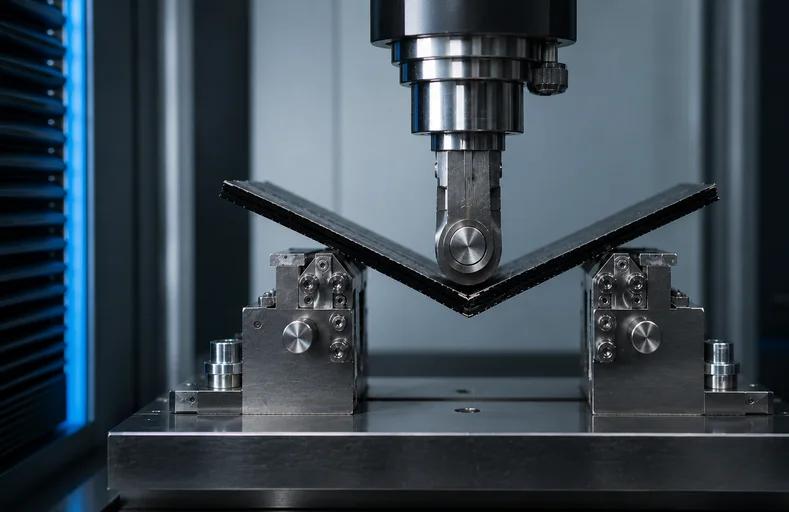
Flexural testing (also called bend testing) places a bar specimen across two supports and applies a load at the midpoint, measuring flexural strength and flexural modulus. ASTM D790 and ISO 178 govern this test for rigid and semi-rigid plastics. Flexural properties are especially relevant for structural components like brackets, housings, and panels. Read our detailed breakdown: ASTM D790 / ISO 178 explained.
What is compression testing for polymers?
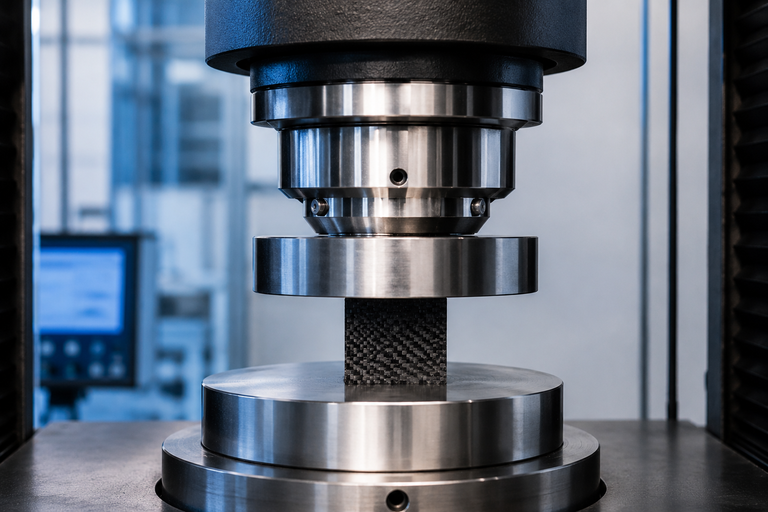
Compression testing measures how a specimen responds to squeezing force — compressive strength, yield point, and deformation behavior. ASTM D695 and ISO 604 are the primary standards. This test is critical for foam, sealants, gaskets, and any polymer used in load-bearing applications where crushing force is the primary stress mode.
What is impact testing for polymers?
Impact tests measure energy absorbed when a specimen fractures under sudden load. The two main methods are Izod (ASTM D256) and Charpy (ASTM D6110 / ISO 179). Impact data identifies whether a material will be brittle or ductile in a real-world collision or drop event. Temperature significantly affects impact behavior — a polymer that passes at room temperature may fail at -20°C.
Surface hardness rounds out the property profile alongside tensile, flexural, compression, and impact. For a worked example using Shore D and Rockwell R on a common thermoplastic, see our guide to the hardness of polypropylene.
What ASTM Standards Apply to Polymer Mechanical Testing?
The most widely referenced standards for polymer mechanical testing are summarized below.
| Test Type | ASTM Standard | ISO Equivalent | Applies To |
|---|---|---|---|
| Tensile (plastics) | ASTM D638 | ISO 527 | Rigid & semi-rigid plastics |
| Tensile (rubber) | ASTM D412 | ISO 37 | Vulcanized & thermoplastic rubber |
| Tensile (film/sheet) | ASTM D882 | ISO 527-3 | Thin plastic films (<1 mm) |
| Flexural | ASTM D790 | ISO 178 | Rigid & semi-rigid plastics |
| Compression | ASTM D695 | ISO 604 | Rigid plastics, foams |
| Izod Impact | ASTM D256 | ISO 180 | Notched specimens, rigid plastics |
| Charpy Impact | ASTM D6110 | ISO 179 | Plastics, composites |
| Hardness (Shore) | ASTM D2240 | ISO 868 | Rubber, soft plastics |
ASTM and ISO standards are not always interchangeable — specimen geometry and conditioning requirements differ between them. Always confirm with the customer or regulator which standard applies before running a batch.
Manual vs. Automated: How Does Automation Change Polymer Testing?
Most lab teams run polymer mechanical testing manually: a technician cuts specimens, mounts them in the grips, starts the test, records the result, and repeats. This works at low volume, but it introduces variability at every handoff. The gripping force varies slightly between operators. Specimen alignment drifts. Data gets re-keyed from the machine display into a spreadsheet.
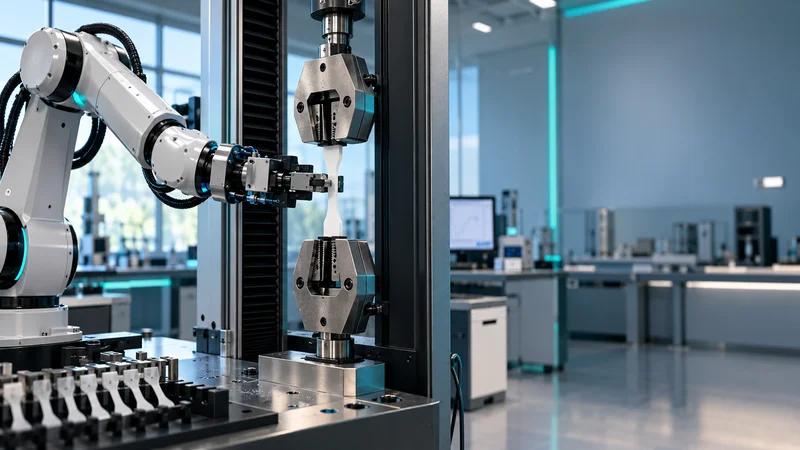
Robotic systems like LabsCubed's CubeTen for plastics — and CubeOne for rubber and elastomers — automate the entire sequence: specimen loading, grip seating, test execution, and data capture, removing operator influence from the repetitive steps. The result is not just faster throughput. It is more consistent data, which is what actually matters when you are qualifying a material or defending a test result to a customer.
| Manual Testing | Recommended CubeOne / CubeTen | |
|---|---|---|
| Specimen loading | Hand-placed; grip force varies by operator | Robotic arm; repeatable grip force every cycle |
| Alignment | Visual check; subject to human error | Sensor-verified; alignment is enforced mechanically |
| Throughput | Typically 15–30 specimens/hr (one tech) | Up to 60–80 specimens/hr unattended |
| Data capture | Manual entry or export; re-keying risk | Direct to LIMS / database; no re-keying |
| Operator-to-operator variability | Present at grip, alignment, and data steps | Eliminated at automated steps; CV typically lower |
| Night / weekend runs | Not practical without overtime | Unattended — runs complete while the lab is empty |
| Audit trail | Paper log or manual CSV | Timestamped digital record per specimen |
The automation angle is what most competitors in this space miss. Published content on polymer mechanical testing focuses almost entirely on test types and standards — it rarely addresses the fact that the biggest source of variability in a mature lab is not the method, it is the operator. Automation solves that problem systematically. Read more: Automation vs. manual testing white paper.
What Are the Most Common Mistakes in Polymer Mechanical Testing?
Even well-run labs make these errors. Each one affects your data reproducibility.
- Wrong crosshead speed for the material type. Stiff thermoplastics test at 5 mm/min; soft elastomers at 500 mm/min. Running a soft rubber at 5 mm/min produces artificially low elongation values. The standard specifies the speed — check it before every run type.
- Specimen dimensions outside tolerance. ASTM D638 Type I, II, III, IV, and V all have different gauge lengths and widths. Mixing types between batches makes results non-comparable. Die-cut specimens drift over time as dies wear — check dimensions on a sample basis each week.
- Off-center gripping. A specimen gripped 2–3 mm off-center introduces bending stress, which lowers tensile strength and increases scatter. This is the single most common manual-testing error and the primary one that robotic loading eliminates.
- Testing at the wrong temperature or humidity. Polymers are viscoelastic — their mechanical properties change significantly with temperature and moisture. ASTM standards specify conditioning (typically 23°C ± 2°C, 50% RH ± 5%). Skipping the conditioning step produces systematically biased data.
- Mismatched load cell range. A 10 kN load cell measuring a 50 N rubber specimen will operate at 0.5% of full scale — well outside accurate range. Match the load cell to the expected break force, targeting 20–80% of capacity for best accuracy.
Temperature and humidity effects are explored further in our post: How temperature and humidity affect tensile strength in plastics.
How Do You Choose a Polymer Mechanical Testing Machine?
The right universal testing machine (UTM) for polymer work depends on four parameters:
- Force range. Soft rubbers break at under 100 N; fiber-reinforced composites may require 100 kN. Most polymer labs need a 5–50 kN machine with interchangeable load cells.
- Speed range. Elastomer testing requires crosshead speeds up to 500 mm/min or higher. Confirm the machine's speed specification covers your full material range.
- Grip type. Pneumatic grips deliver consistent grip force regardless of operator; manual screw grips depend on individual technique. For high-volume or automated labs, pneumatic or hydraulic grips are the practical choice.
- Automation readiness. If throughput is a constraint, evaluate from the start whether the machine can integrate with robotic specimen handling. Retrofitting automation to a machine not designed for it is expensive and often incomplete.
Thinking about automation for your lab? See how automated data collection saves time at the post-test step.
Frequently Asked Questions About Polymer Mechanical Testing
What is polymer mechanical testing?
Polymer mechanical testing measures how a plastic or rubber material responds to applied forces — tension, compression, flexure, and impact — using standardized methods such as ASTM D638, D790, D695, and D256. Labs use these results to confirm materials meet specification and qualify suppliers before production begins.
What are the most important types of polymer mechanical testing?
The four core test types for polymers are tensile (ASTM D638 / ISO 527), flexural (ASTM D790 / ISO 178), compression (ASTM D695 / ISO 604), and impact (ASTM D256 / ISO 180). Tensile testing is the most common because it produces tensile strength, elongation, and modulus in a single run.
How does automated polymer testing reduce variability?
Manual testing introduces variability at grip loading, alignment, and data entry — all steps that depend on the individual operator. Robotic systems like LabsCubed's CubeTen and CubeOne automate specimen loading, grip seating, and data capture end-to-end, removing operator influence from the repetitive steps that drive batch-to-batch scatter.
Take the operator out of the variability equation
Explore how LabsCubed's CubeTen and CubeOne systems automate specimen loading, testing, and reporting for plastics and rubber QA labs. Bring your standards, your materials, and your throughput numbers, and we will map the fit.