The tensile strength of polypropylene (PP) typically falls around 25–40 MPa for many unfilled homopolymer grades, but there is no single value that represents every polypropylene material. Copolymers, mineral-filled grades, glass-fibre-reinforced PP, and highly oriented PP can produce substantially different results.
Tensile strength is also affected by specimen preparation, molecular orientation, crystallinity, strain rate, temperature, conditioning, and the consistency of the testing procedure. That is why comparing a single published number with your laboratory result can be misleading unless the grade, specimen, standard, and test conditions are comparable.
For plastics laboratories, the goal is therefore not simply to obtain a tensile-strength number. It is to produce a result that is repeatable, traceable, and representative of the material being tested.If you need a broader introduction to the mechanics behind the test, see what tensile testing actually measures.
What is the tensile strength of polypropylene?
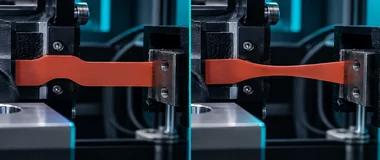
Tensile strength describes how much tensile stress a polypropylene specimen can withstand before reaching a defined failure point. During a tensile test, a standardized specimen is gripped and pulled at a controlled rate while the testing system records force and deformation.
The resulting stress-strain curve can be used to determine several important properties, including:
Tensile strength at yield
Ultimate tensile strength
Young's modulus
Yield strain
Elongation at break
Stress-strain behavior
For many unfilled PP homopolymers, tensile strength at yield is commonly in the 25–35 MPa range, while ultimate tensile strength is often around 30–40 MPa. These values are only reference ranges, however. The actual result depends heavily on the specific grade and test conditions.
A filled or highly oriented polypropylene can behave very differently from a conventional injection-moulded homopolymer.
What Are Typical Tensile Strength Values for Polypropylene?
There is a wide range of reported tensile strength values for polypropylene because "PP" covers many different formulations and material structures.
As a general reference:
| Polypropylene type | Typical tensile strength range CubeOne & CubeTen By LaBSCUBED |
|---|---|
| PP homopolymer | ~30–40 MPa |
| PP copolymer | ~20–30 MPa |
| Talc-filled PP | ~25–45 MPa |
| Glass-fibre-reinforced PP | ~70–110 MPa or higher, depending on grade |
| Highly oriented / fibre-grade PP | Can reach several hundred MPa along the orientation direction |
*Indicative ranges only. Actual values depend on grade, formulation, specimen geometry, processing history, orientation, conditioning, and test method.
This wide range is why a search for "the tensile strength of polypropylene" should not end with a single number.
Why can polypropylene have such different tensile strength values?
Polypropylene is a semi-crystalline thermoplastic, and its mechanical properties depend strongly on how its molecular structure and reinforcement are arranged.
For example:
Homopolymer PP generally provides higher stiffness and strength than many impact copolymer grades.
Talc and mineral fillers can change stiffness and tensile behavior.
Glass fibres can substantially increase tensile strength and modulus.
Molecular orientation can increase strength in the direction of alignment.
Processing conditions influence crystallinity and the resulting mechanical properties.
Temperature and strain rate change how the polymer responds during the test.
The result is that two materials both labelled "polypropylene" can produce meaningfully different tensile results.
How Is Polypropylene Tensile Strength Tested?
Polypropylene tensile strength is commonly measured using ASTM D638 or ISO 527, depending on the requirements of the laboratory, customer, market, or product specification.
Both standards define requirements for specimen geometry, conditioning, test setup, deformation measurement, test speed, and reporting. They should not be treated as interchangeable methods without considering their specific requirements.
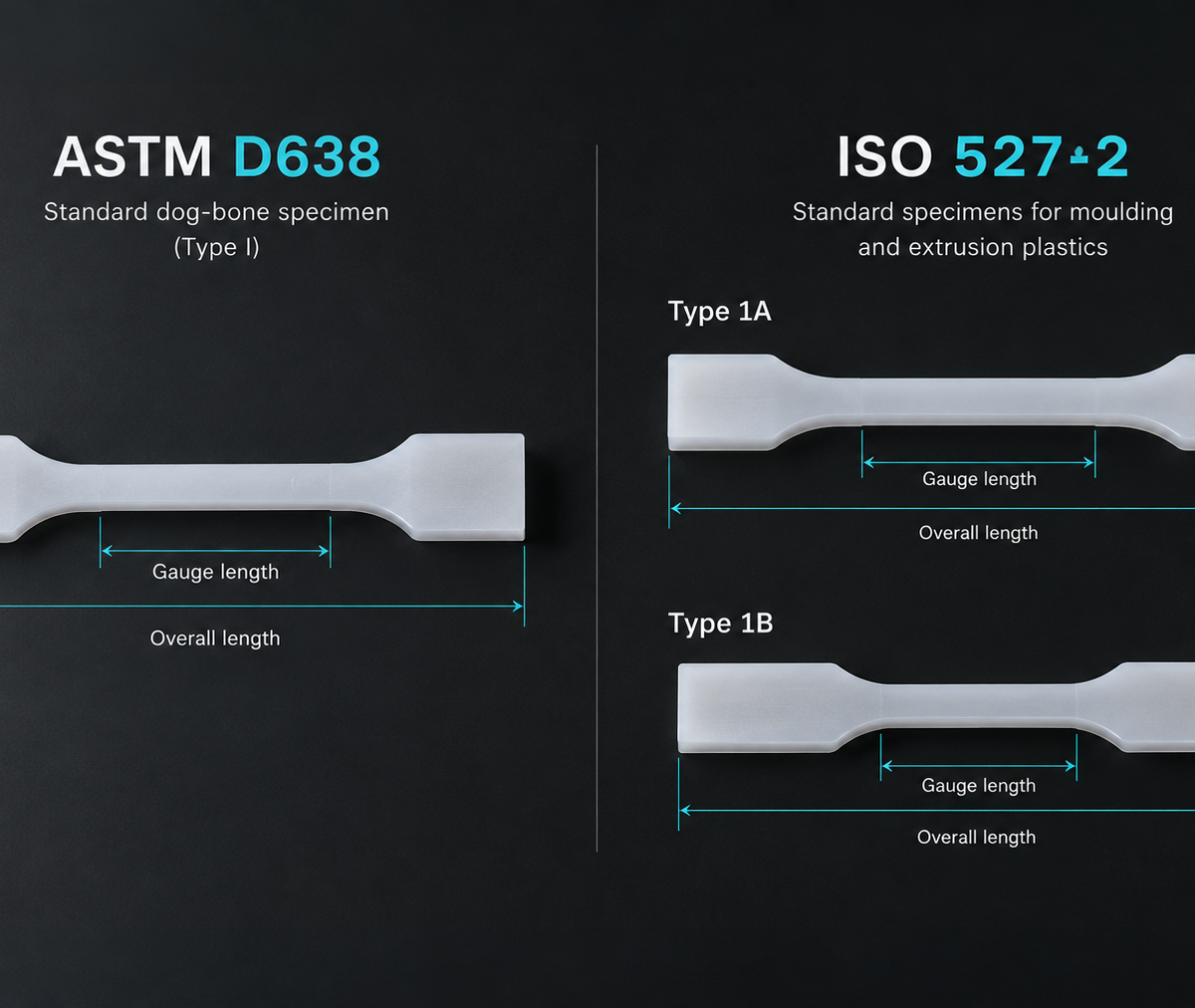
- ASTM D638
ASTM D638 is one of the primary standards used to determine the tensile properties of plastics. It evaluates how a plastic specimen behaves under uniaxial tensile loading and can provide tensile strength, yield behavior, elongation, modulus, and related properties.
For rigid and semi-rigid plastics, the test generally uses a standardized dog-bone specimen.
LabsCubed's ASTM D638 guide provides a more detailed walkthrough of specimen setup, testing equipment, extensometry, and data collection.
- ISO 527
ISO 527 is the corresponding international family of standards for determining the tensile properties of plastics.
ISO 527-2 covers tensile testing of moulding and extrusion plastics and uses defined specimen geometries such as Type 1A and Type 1B.
Although ASTM D638 and ISO 527 address similar mechanical properties, their specimen dimensions, test procedures, and calculation/reporting requirements are not identical. Results should therefore always be identified with the standard and conditions under which they were obtained.
What Does a Polypropylene Tensile Test Measure?
A tensile test provides more information than a single tensile-strength value.
- Tensile strength at yield
Yield strength identifies the stress at which the specimen begins to undergo significant permanent deformation.
For ductile polypropylene, this can be particularly important because the material may continue to deform substantially after yielding rather than immediately fracturing.
- Ultimate tensile strength
Ultimate tensile strength is the maximum engineering stress reached during the tensile test.
This is often the value people mean when they ask for the "tensile strength of polypropylene," but the report should make clear whether the value refers to yield or ultimate strength.
- Young's modulus
Young's modulus describes the material's stiffness in the initial, approximately linear portion of the stress-strain response.
A higher modulus means the material requires more stress to produce a given amount of elastic deformation.
- Elongation at break
Elongation at break indicates how much the specimen deforms before failure.
This is particularly useful when comparing ductile and reinforced PP grades because two materials with similar tensile strength can behave very differently in terms of deformation.
- Stress-strain behavior
The complete stress-strain curve provides a much more informative picture of polypropylene's mechanical behavior than tensile strength alone.
It shows how the material transitions from elastic deformation through yielding and plastic deformation toward failure.
Why Does Polypropylene Tensile Strength Vary?
The same polypropylene grade can produce different tensile results when the material, specimen, environment, or testing workflow changes.
The most important sources of variation are below.
1. Polymer grade and formulation
Polypropylene is available in homopolymer, random copolymer, impact copolymer, filled, reinforced, and highly modified grades.
Additives and reinforcement change the material's mechanical response, so results should always be compared between like-for-like grades.
2. Crystallinity and molecular orientation
Polypropylene is semi-crystalline. Its crystallinity and molecular orientation are influenced by processing conditions such as moulding, extrusion, drawing, and cooling.
Orientation can be especially important because tensile properties may become direction-dependent. A specimen tested parallel to an orientation direction may behave very differently from one tested perpendicular to it.
3. Fillers and reinforcement
Mineral fillers and glass fibres can significantly change tensile behavior.
Glass-fibre-reinforced PP, for example, can achieve much higher tensile strength and stiffness than unfilled PP. However, the result depends on fibre content, fibre orientation, matrix formulation, and specimen preparation.
4. Strain rate
Polypropylene is a viscoelastic material, meaning its response depends partly on the rate at which it is deformed.
Changing the crosshead speed can therefore change the measured tensile response. This is one reason why test results should never be compared without checking the applicable standard and test speed.
5. Temperature and conditioning
Temperature can significantly affect polymer mechanical behavior. As temperature increases, plastics generally become softer and less stiff, while lower temperatures can increase rigidity and, depending on the material, brittleness.
Humidity is generally less influential for polypropylene than for moisture-sensitive polymers because PP absorbs relatively little moisture. However, controlled environmental conditions are still important for producing comparable test results.
6. Specimen preparation
Poorly moulded, damaged, warped, contaminated, or incorrectly machined specimens can introduce variation before the test even begins.
For polypropylene, processing history can also become part of the measured result. If specimens are produced differently, the tensile test may be measuring differences in specimen structure rather than simply differences in the resin.
7. Testing workflow
The final source of variability is the way the test itself is performed.
Specimen alignment, gripping, strain measurement, test-speed setup, data capture, and operator interpretation can all introduce variation.
This is particularly relevant in laboratories running large numbers of PP specimens.
Manual vs. Automated Polypropylene Tensile Testing
Automation does not eliminate material variability. Instead, its value is in standardizing the parts of the workflow that should remain consistent from specimen to specimen.
| Workflow step | Manual testing | Automated testing |
|---|---|---|
| Specimen loading | Operator loads and positions each specimen | Robotic handling can standardize specimen loading and positioning |
| Alignment | Depends on operator technique | A defined loading sequence improves consistency |
| Test setup | Parameters may be entered or checked manually | Test parameters can be stored within the workflow |
| Strain measurement | May require manual extensometer placement | Automated or non-contact measurement can reduce setup variation |
| Data capture | Manual transfer may be required | Results can be captured digitally |
| Reporting | Operator compiles and reviews results | Digital workflows can standardize result collection and reporting |
| Traceability | Depends on laboratory procedure | Specimen IDs and test records can be linked automatically |
For laboratories running repeated ASTM D638 or ISO 527 testing, the advantage is not simply that a machine can pull more specimens. It is that the same sequence can be applied repeatedly, reducing unnecessary operator-dependent steps.
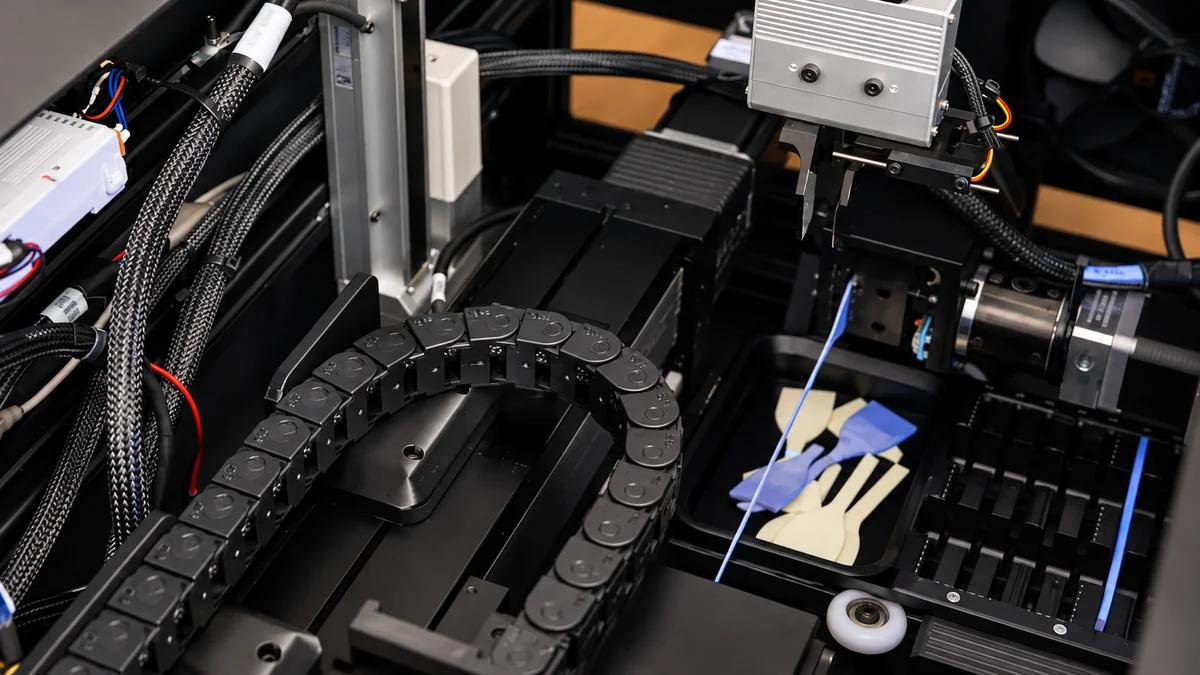
LabsCubed's broader approach to automated tensile testing focuses on specimen handling, testing, data capture, and traceability rather than simply automating the load frame.
Cut PP tensile scatter without changing your method.
See how CubeTen runs up to 15 polypropylene specimens unattended to ASTM D638 with a video extensometer and audit-ready record.
Common Mistakes When Measuring Polypropylene Tensile Strength
When a PP result does not agree with a datasheet or previous batch, the first step should be to review the testing workflow rather than assume the material has changed.
- Using the wrong test speed
Crosshead speed affects polymer behavior. Always use the speed specified by the applicable test method or material specification.
- Comparing results from different standards
ASTM D638 and ISO 527 use different specimen geometries and procedural requirements. A result generated under one method should not automatically be compared with a result generated under the other.
- Inconsistent specimen preparation
Differences in moulding, machining, thickness, orientation, or surface condition can produce genuine differences in tensile behavior.
- Poor specimen alignment
A specimen that is not properly centered or aligned in the grips can introduce unwanted stresses and affect the measured result.
- Inconsistent strain measurement
Extensometer placement and measurement technique matter when calculating modulus, yield strain, and other deformation-related properties.
- Ignoring the testing environment
Temperature differences can affect polymer behavior, even when the material itself has not changed. Environmental conditions should therefore be controlled and documented where required by the method.
- Relying on too few results
A single specimen cannot represent the behavior of a material batch. Replicate testing helps reveal scatter and makes it easier to identify abnormal results.
- Manually transferring data
Even when the mechanical test itself is correct, manually copying force, strain, specimen ID, or calculated results into another system creates opportunities for transcription errors.
Digital data collection can reduce this unnecessary step. LabsCubed discusses this broader issue in its guide to tensile data collection and automation.
How Does Polypropylene Compare With Other Plastics?
Tensile strength comparisons between plastics are useful as a general reference, but they should always be made under comparable test conditions.
As a broad indication, unfilled PP generally falls within the same overall strength range as other commodity thermoplastics such as polyethylene, while engineering plastics such as polycarbonate and nylon can offer higher tensile strength depending on grade.
The important point is that polymer family alone does not determine tensile strength.
Grade, molecular structure, reinforcement, processing history, specimen orientation, temperature, and test method can all change the result.
For material selection, compare datasheet values only when the underlying testing conditions are sufficiently similar.
How Can You Improve the Repeatability of Polypropylene Tensile Testing?
Improving PP tensile-test repeatability starts with controlling the variables that should not change between specimens.
A practical workflow includes:
Use the correct test standard for the application.
Prepare specimens consistently, including geometry and processing conditions.
Condition specimens as required by the applicable method.
Control crosshead speed and test parameters.
Align specimens consistently in the grips.
Use appropriate strain measurement.
Test enough specimens to characterize the batch.
Capture specimen and test data digitally.
Standardize the workflow across operators and shifts.
Review the complete stress-strain data rather than relying only on the headline tensile-strength value.
For laboratories with high testing volumes, automation can standardize many of these repetitive steps.
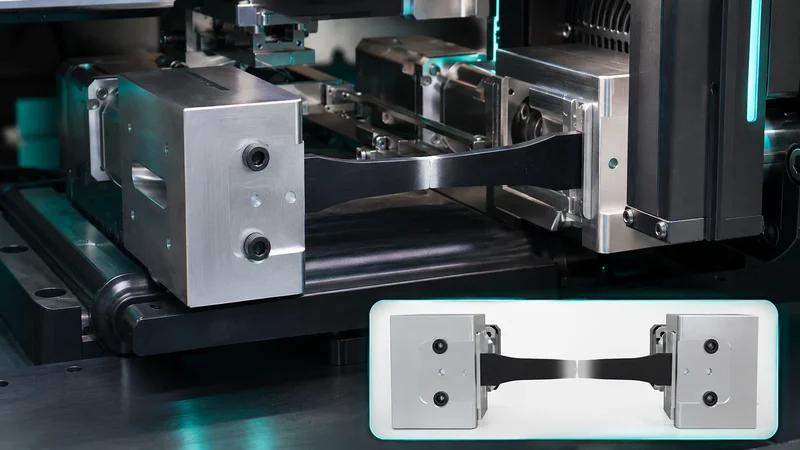
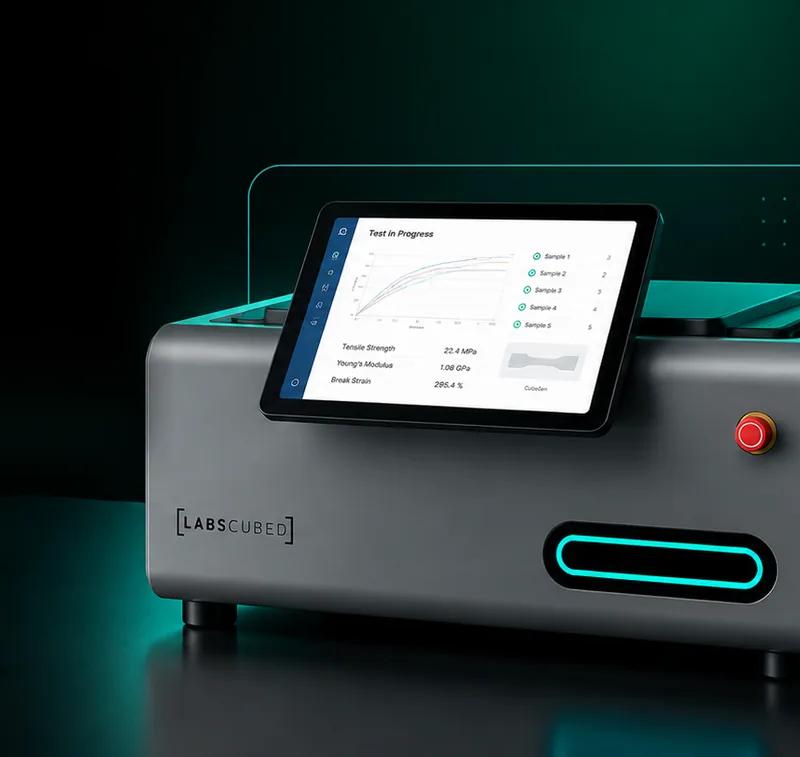
LabsCubed's CubeTen plastic testing system supports ASTM D638 and ISO 527 workflows and is designed for automated handling of multiple plastic tensile specimens.
Frequently asked questions
What is the typical tensile strength of polypropylene?
The tensile strength of polypropylene is typically 30–40 MPa (about 4,500–5,800 psi) for neat homopolymer tested per ASTM D638 at 23 °C. Copolymer grades sit lower, around 20–30 MPa, while glass-fibre-reinforced PP can reach 70–110 MPa or more. Always test the specific grade you plan to use rather than relying on a single published number.
Is polypropylene stronger than HDPE?
HDPE is usually slightly stronger in tension than unfilled PP because its denser, more linear molecular structure resists pulling forces better. Typical HDPE values are around 25–35 MPa versus 30–40 MPa for PP homopolymer, so the two overlap heavily. PP wins on stiffness and heat resistance; HDPE wins on impact toughness and chemical resistance.
Which test standard is used for polypropylene tensile strength?
Polypropylene tensile strength is measured under ASTM D638 in North America and ISO 527-1/-2 internationally. Both pull a Type I dog-bone specimen at a controlled rate while recording force and strain. Specimens are conditioned at 23 °C / 50% RH for at least 40 hours and a minimum of five valid specimens are averaged per result.
Why do published polypropylene tensile strength values vary so much?
Published values vary because polypropylene tensile strength depends on grade, fillers, crystallinity, orientation, strain rate, temperature, and how the test was run. The same homopolymer can read 28 MPa or 36 MPa depending on conditioning and operator handling. Treat any single literature value as a typical figure and verify it on your own specimens before designing to it.
Does polypropylene tear or break easily under tension?
Polypropylene resists breaking under tension reasonably well — it typically elongates 100–600% before failure, which is why it's used in living hinges and packaging. But unfilled PP yields at relatively low stress (25–35 MPa), so it deforms permanently before catastrophic failure. Glass-filled grades are stiffer and stronger but more brittle.
How can I reduce variability in my polypropylene tensile results?
The biggest gains come from standardising specimen prep and conditioning, using a video extensometer instead of a clip-on, and automating the load-and-pull cycle so every specimen sees the same alignment, grip pressure, and pull rate. Automated systems like CubeTen also auto-log method, environment, and operator, which removes the most common source of transcription error from your reported numbers.
Test polypropylene with less variability and more throughput.
If the spread in your PP numbers is wider than your design margin can absorb, automating the workflow is usually the highest-leverage fix. Book a 20-minute walkthrough of CubeTen — we'll bring your standards, your materials and your numbers.