A tensile tester is a precision instrument that pulls a specimen of plastic, rubber, metal, composite, or film at a controlled rate until it deforms or breaks, then records the force and elongation as a stress–strain curve. The numbers it reports — tensile strength, yield strength, modulus, and elongation at break — are what your customers, your QA system, and ASTM/ISO standards rely on. At LabsCubed we build automated tensile testers (CubeOne for single-frame work, CubeTen for high-throughput labs) that take operator variability out of the result.
In this guide you'll learn what a tensile tester actually does inside the frame, the four main types you'll encounter, the standards they typically run, the most common testing mistakes, and a clear-eyed comparison of manual vs. automated workflows — so you can decide whether your lab needs a benchtop unit, a floor-standing universal testing machine, or an automated cell.
What is a tensile tester?
A tensile tester is a mechanical testing instrument that pulls a material specimen at a controlled rate while measuring force and deformation. The resulting stress-strain data can be used to determine properties such as tensile strength, yield strength, Young's modulus, and elongation at break.
Tensile testers are used across plastics, rubber, composites, films, adhesives, metals, and other materials. The machine itself is only one part of the test, however. The specimen geometry, grips, strain measurement, test speed, conditioning, data collection, and applicable standard all influence the final result.
For laboratories running repeated tensile tests, this distinction matters. A well-specified tensile tester can provide the required force and measurement capability, but a consistent testing workflow is what helps make results repeatable from specimen to specimen.
How does a tensile tester work?
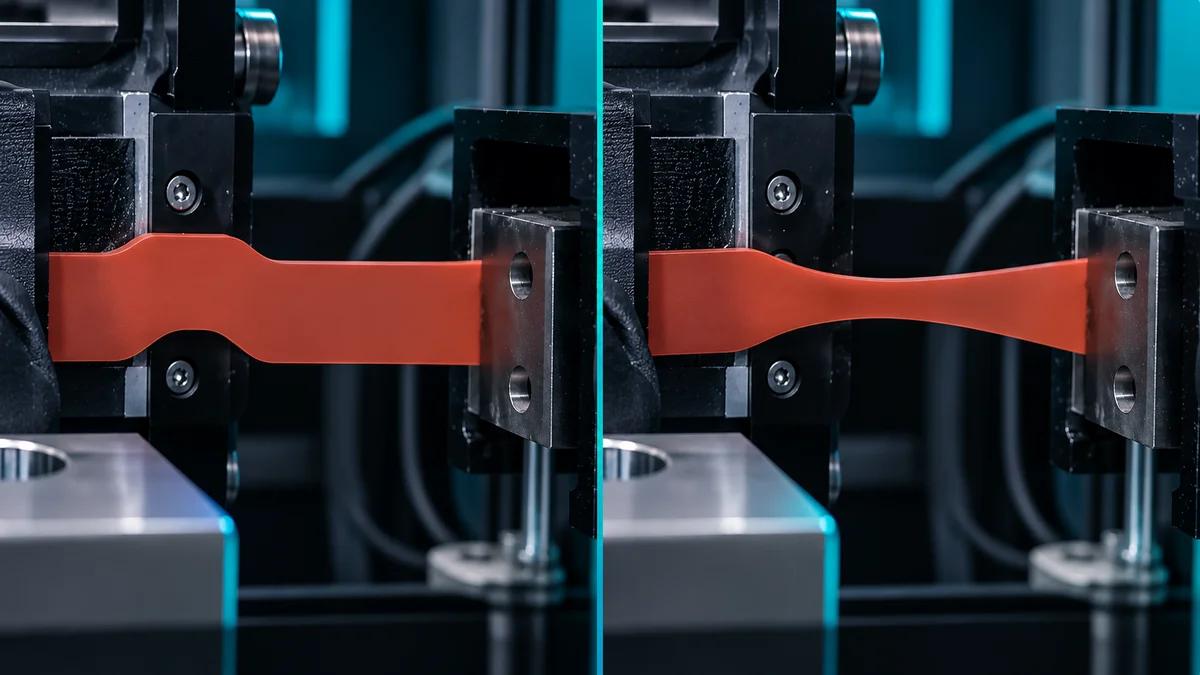
A tensile tester applies a steady, controlled displacement (typically in millimeters per minute) to one grip while the opposite grip is fixed. A load cell in line with the moving crosshead reads force in real time, and a strain measurement device tracks how much the specimen elongates. The controller plots force against elongation, converts it to engineering stress and strain, and reports the values defined by the test method.
Frame & drive
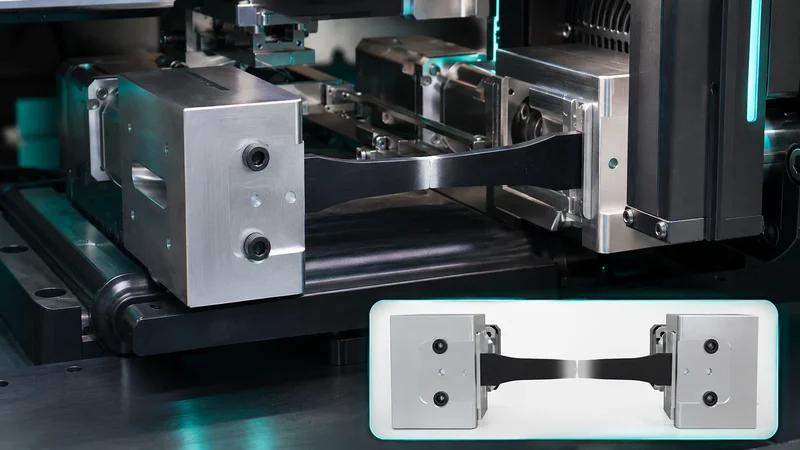
Column(s), ballscrew or servo drive, and crosshead producing pulling motion at a precise rate.
Load cell
Strain-gauge transducer sized to peak load. Typically ASTM E4 / ISO 7500-1 Class 0.5 or better.
Grips
Wedge, pneumatic, or hydraulic, matched to the specimen — dogbone, ring, rebar, film strip.
Strain device
Crosshead, contact, or non-contact video extensometer. Video wins on high-elongation rubber and films.
What does a tensile test actually measure?
A tensile tester can generate several important mechanical properties from a single test.
Tensile strength
Tensile strength describes the maximum tensile stress reached during the test. Depending on the material and standard, the relevant value may be tensile strength at yield or the maximum stress before failure.
Yield strength
Yield strength identifies the point at which the material begins to undergo significant permanent deformation.
For ductile plastics, this can be particularly important because the specimen may continue to stretch considerably after yielding.
Young's modulus
Young's modulus describes the material's stiffness in the approximately linear elastic region of the stress-strain curve.
A higher modulus indicates greater resistance to elastic deformation.
Elongation at break
Elongation at break describes how much the specimen stretches before failure, usually expressed as a percentage.
It is especially useful when comparing materials with very different deformation behavior.
Stress-strain curve
The stress-strain curve is often more informative than a single headline value.
It shows how the material responds as deformation increases and allows the laboratory to evaluate its stiffness, yield behavior, plastic deformation, and failure behavior.
The exact properties reported depend on the material and test method. For example, plastics, rubber, and composites do not use identical reporting requirements.
What are the main types of tensile testers?
"Tensile tester" can refer to several different types of systems. The right configuration depends on the materials you test, required force range, test standards, specimen geometry, and testing volume.
Benchtop tensile testers
Benchtop systems are compact machines designed for routine laboratory testing.
They are commonly used when the required force capacity is relatively modest and laboratory space is limited.
Typical applications include:
Plastics
Films
Rubber and elastomers
Foams
Adhesives
Small components
2. Floor-standing tensile testers
Floor-standing systems provide greater space and force capacity and are often used for a wider range of materials and specimen geometries.
They may be configured for plastics, composites, metals, rubber, and other engineering materials.
3. Universal testing machines
A universal testing machine (UTM) is a broader category of mechanical testing system capable of performing tensile testing as well as other tests such as compression and flexure when the appropriate fixtures are installed.
This makes a UTM useful for laboratories that need one platform for multiple mechanical testing methods.
4. Automated tensile testing systems
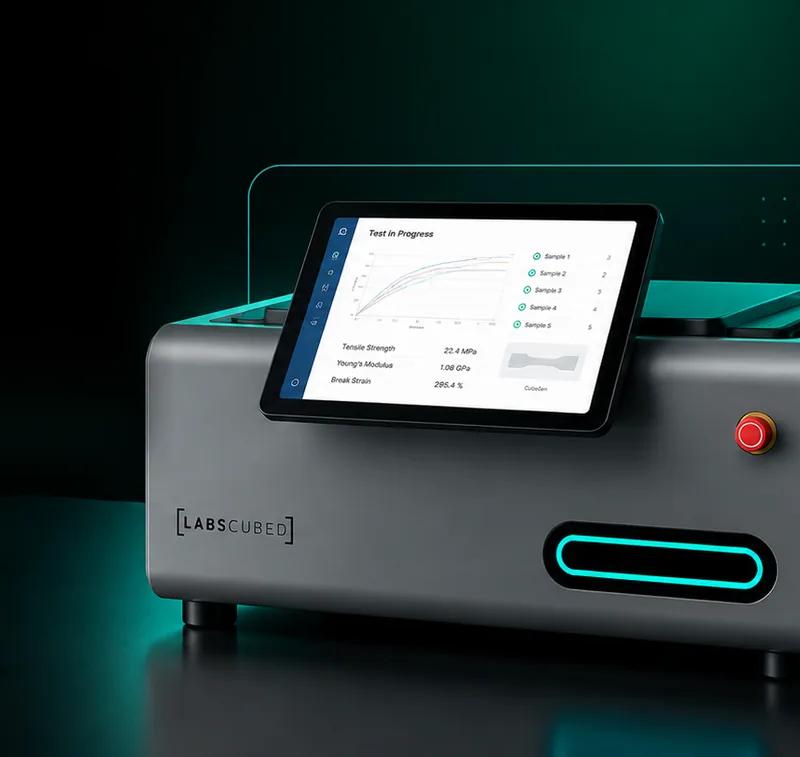
An automated tensile testing system combines the testing frame with automation around the test itself.
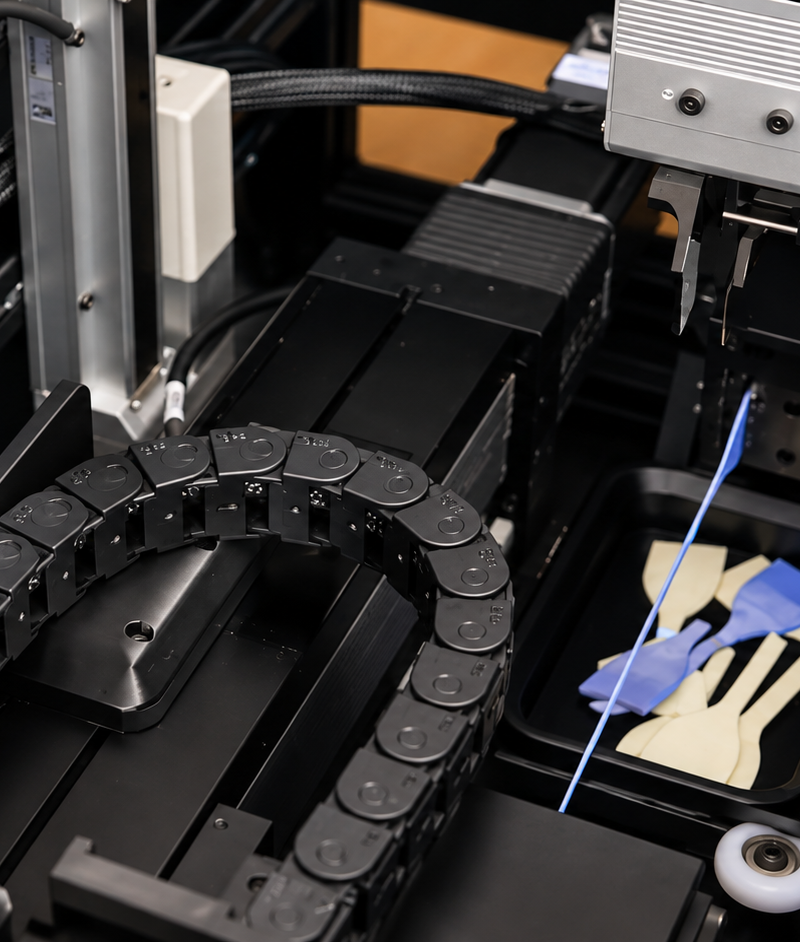
Instead of requiring an operator to manually load every specimen, initiate every test, record every result, and prepare the next specimen, the system can automate parts of the workflow such as:
Specimen handling
Positioning and alignment
Measurement
Test execution
Data capture
Result processing
Reporting
This is where the distinction between a tensile tester and an automated tensile testing workflow becomes important. Automation focuses not only on the machine that performs the pull, but also on the repetitive steps surrounding it.
Tensile Tester vs. Universal Testing Machine: What's the Difference?
The terms are sometimes used interchangeably, but they do not always mean the same thing.
A tensile tester is generally configured around tensile testing.
A universal testing machine can perform multiple mechanical tests by changing the grips, fixtures, and test method.
For example, a UTM may be configured for:
Tensile testing
Compression testing
Flexural testing
Shear testing
Peel testing
The better choice depends on your laboratory's actual testing requirements.
If tensile testing is the primary application, a dedicated tensile system may provide a simpler workflow. If the lab regularly performs several mechanical test types, a universal frame may provide greater flexibility.
Which Standards Does a Tensile Tester Run?
A tensile tester does not determine which standard is used. The test method determines how the machine is configured and how the result is calculated and reported.
Common standards include:
| Material / application | Common standard |
|---|---|
| Plastics | ASTM D638 / ISO 527 |
| Rubber and elastomers | ASTM D412 / ISO 37 |
| Thin plastic film | ASTM D882 |
| Polymer-matrix composites | ASTM D3039 / ISO 527-4 / ISO 527-5 |
| Metals | ASTM E8 / E8M |
The applicable standard defines requirements such as specimen geometry, conditioning, test speed, strain measurement, calculations, and reporting.
That means choosing a tensile tester based only on maximum force is not enough. The system should also support the methods and specimen geometries your laboratory actually runs.
For plastics, see the detailed ASTM D638 / ISO 527 tensile testing guide. For a broader overview of polymer testing, see the polymer tensile testing guide.
What Should You Consider When Choosing a Tensile Tester?
Buying a tensile tester should start with the testing workflow, not the machine's maximum specification.
Force capacity
Choose a load range that covers the materials you actually test.
A system should provide sufficient capacity for your highest expected loads while maintaining appropriate measurement performance at lower loads.
Crosshead speed
Different materials and standards require different test speeds.
Make sure the machine can achieve the speeds required by your current methods and any foreseeable applications.
Grip compatibility
Your grips should match the specimen geometry and material.
A grip that works well for a rigid plastic dog-bone may not be appropriate for a highly extensible rubber specimen or a thin film.
Strain measurement
Determine whether your methods require:
Crosshead displacement
Contact extensometry
Non-contact extensometry
High-elongation measurement
The measurement system should be selected according to the properties you need to report.
Software and data management
Consider how results move from the testing machine into your laboratory's quality system.
Useful capabilities can include:
Method templates
Automatic calculations
Digital specimen identification
Result storage
Report generation
Data export
LIMS or other system integration
Audit trails
Automation readiness
If testing volume is increasing, consider whether the system can support automation rather than treating automation as an afterthought.
A laboratory that expects to move from occasional testing to repeated daily testing may benefit from evaluating the complete workflow from the beginning.
Manual vs. Automated Tensile Testing
The difference between manual and automated testing is not simply whether the machine has a robot.
In a manual workflow, the technician typically handles the specimen, positions it in the grips, initiates the test, monitors the result, records or transfers the data, and prepares the next specimen.
In an automated workflow, those repetitive steps can be integrated into a defined sequence.
| Manual tensile tester |
Recommended CubeOne / CubeTen |
|
|---|---|---|
| Technician time per batch of 15 | ~3–4 hours | ~12 minutes loading, then walk away |
| Specimens per unattended run | 1 | Up to 15 |
| Specimen measurement | Manual caliper, manually typed | Automatic, logged with the result |
| Strain measurement | Crosshead or contact extensometer | Non-contact video extensometer |
| Operator-to-operator variability | Typically the largest source of scatter | Effectively removed |
| ASTM / ISO audit trail | Manual entry into LIMS | |
| Overnight / second-shift throughput |
The reason competitors miss this comparison is that they sell the frame, not the workflow. A tensile tester that depends on a careful operator for repeatable numbers is only as repeatable as that operator's day. Reducing operator-to-operator variability — not just saving time — is typically the largest payoff of automating a tensile tester.
What Are the Most Common Tensile Testing Mistakes?
Many tensile-test problems originate outside the load frame itself.
Poor specimen alignment
Misalignment can introduce unwanted stresses and affect the measured response.
The specimen should be positioned consistently along the machine's loading axis.
Grip slip
Grip slip can distort the force-displacement relationship and make strain measurements unreliable.
The grip type, pressure, surface condition, and specimen material should all be considered.
Incorrect specimen dimensions
Stress calculations depend on specimen dimensions. Errors in width or thickness can therefore become errors in calculated stress.
Consistent specimen preparation and measurement are essential.
Incorrect test speed
Crosshead speed is part of the test method.
Using the wrong speed can produce valid-looking data that is nevertheless not comparable with results generated under the specified method.
Inadequate conditioning
Many polymer standards specify environmental conditioning before testing.
Skipping or changing the conditioning procedure can affect the material response and make comparisons less meaningful.
Inconsistent strain measurement
The method used to measure deformation affects calculated modulus, strain, and other properties.
This becomes especially important for highly extensible materials.
Manual data transcription
Copying results from a machine into a spreadsheet or another system introduces another opportunity for error.
Where testing volumes are high, digital data capture can reduce unnecessary manual handling.
When Should You Automate a Tensile Tester?
Automation becomes more relevant as the laboratory moves from occasional testing toward repeated, high-volume workflows.
Common signals include:
Technicians spend significant time loading and unloading specimens.
Testing backlogs are becoming common.
The same method is repeated many times per day.
Multiple operators produce noticeably different workflows.
Results require substantial manual transcription.
The laboratory needs stronger traceability.
Testing is extending into additional shifts.
Quality or production teams need results faster.
Automation is not automatically the right answer for every laboratory.
If you run a small number of tests each week, a well-configured manual tensile tester may be entirely appropriate.
If your team is performing dozens of repetitive tests every day, however, the limiting factor may no longer be the tensile frame. It may be everything the operator has to do before, during, and after each test.
That is where workflow automation becomes valuable.
How Much Does a Tensile Tester Cost?
The cost of a tensile tester depends heavily on the machine's force capacity, grips, extensometry, software, fixtures, environmental requirements, and level of automation.
A basic laboratory tensile tester can be substantially less expensive than a fully configured universal testing machine or automated testing cell.
Rather than comparing machines by price alone, evaluate the total testing workflow:
How many specimens are tested?
How much technician time does each test require?
What standards must the system support?
What grips and fixtures are required?
What strain measurement is needed?
How are results recorded and reported?
Will testing volume increase?
Will automation be needed later?
For a laboratory running high volumes, the lowest purchase price is not necessarily the lowest-cost testing workflow.
How Do You Know Which Tensile Tester Is Right for Your Lab?
Start with five questions:
1. What materials do you test?
Plastics, rubber, composites, films, and metals can require very different fixtures, strain measurement, and test conditions.
2. Which standards do you run?
Build the equipment specification around the ASTM, ISO, customer, or internal methods your laboratory actually uses.
3. What is your force range?
Choose a load-cell range that fits your specimens rather than selecting a machine solely because it has the highest available capacity.
4. How many specimens do you test?
Testing volume determines whether manual operation remains practical or whether automation could provide meaningful value.
5. How much operator involvement does the workflow require?
If technicians spend most of their time loading specimens, starting tests, recording results, and preparing the next sample, the opportunity may be larger than simply buying a faster tensile frame.
Frequently asked questions
How much does a tensile tester cost?
A new benchtop tensile tester typically lands in the $15,000–$60,000 range, depending on capacity, grips, and software. Floor-standing universal testing machines run $40,000–$160,000. An automated tensile cell (frame plus robotic loading, auto measurement, video extensometry, and audit-ready software) starts higher but typically pays back in 12–18 months at production-lab volumes.
What does a tensile test actually test for?
A tensile test measures a material's response to a pulling force, producing tensile strength, yield strength, Young's modulus, and elongation at break. Labs use those numbers to qualify incoming materials, verify a cure or compound, prove a design margin, and satisfy ASTM/ISO and customer specifications.
What machine is used for a tensile test?
A tensile test is performed on a tensile tester — also called a tensile testing machine or, when configured for compression and flexure as well, a universal testing machine (UTM). The frame holds a load cell, an extensometer or video strain system, grips matched to the specimen, and controller software that loads the test method and reports the result.
How accurate is a modern tensile tester?
The frame and load cell are typically Class 0.5 (ASTM E4 / ISO 7500-1), meaning force is accurate to within 0.5 % of indicated value. The bigger driver of accuracy in production is usually specimen preparation and operator handling — not the frame — which is why automating loading and measurement typically narrows the scatter more than upgrading the frame would.
Can one tensile tester run both plastics and rubber?
Yes, depending on workflow. A dual-column UTM with the right grips and a controller that holds both methods can switch between ASTM D638 (plastics) and ASTM D412 (rubber) in minutes. LabsCubed's CubeOne is built for that mixed workload — one frame, both standards, automatic method recall.
Is automated tensile testing only for large labs?
No. The threshold is throughput consistency, not lab size. A small lab running a tight ASTM/ISO spec for an automotive or medical customer often automates earlier than a large lab running internal-only tests, because the cost of a variance finding is higher. CubeOne is sized for that case.
See an automated tensile tester run your standard
Book a 20-minute walkthrough of CubeOne and CubeTen. We'll bring your standards, your materials and your numbers.